2.1 Ionic bonding
How metal atoms lose electrons and non-metal atoms gain electrons to form ions with full outer shells, drawing dot and cross diagrams for ionic compounds, and working out the numbers of protons, neutrons and electrons in ions.
Forming ions
Key terms
- Ion: an atom or group of atoms with a positive or negative charge.
- Ionic bond: the strong electrostatic attraction between oppositely charged ions.
Ionic bonding happens when a metal reacts with a non-metal. Electrons are transferred from the metal atoms to the non-metal atoms:
- metal atoms lose their outer electrons to form positive ions (cations)
- non-metal atoms gain electrons to form negative ions (anions)
Both ions end up with a full outer shell, the same electronic structure as a noble gas. The oppositely charged ions attract each other strongly.
| Group | Electrons lost or gained | Charge | Example |
|---|---|---|---|
| 1 | lose 1 | 1+ | \mathrm{Na^+} |
| 2 | lose 2 | 2+ | \mathrm{Mg^{2+}} |
| 6 | gain 2 | 2− | \mathrm{O^{2-}} |
| 7 | gain 1 | 1− | \mathrm{Cl^-} |
Dot and cross diagrams
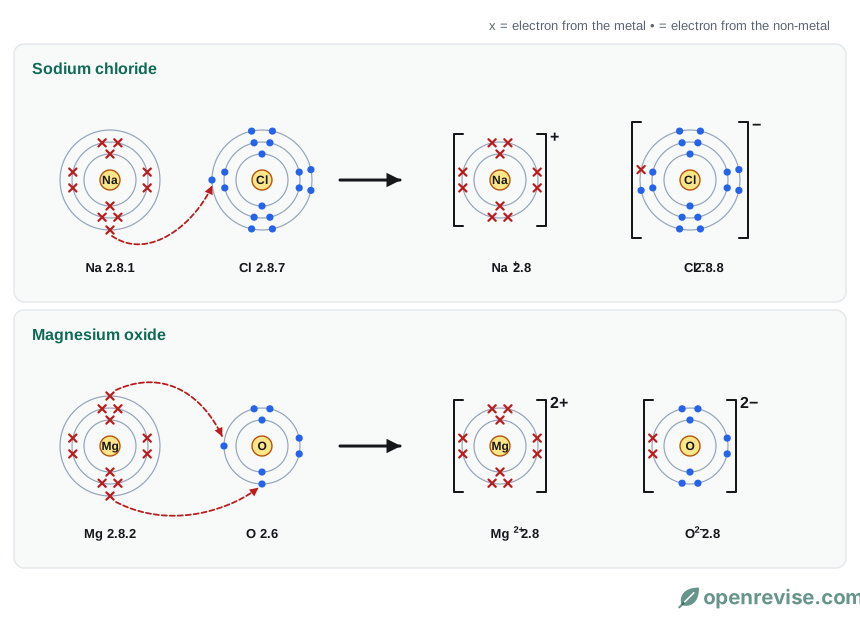
- Show the electrons of one atom as dots and the other as crosses, so you can see where each electron came from.
- Draw each ion in square brackets with its charge at the top right.
- You can draw just the outer shell of each ion.
Magnesium chloride: a magnesium atom has 2 outer electrons, but a chlorine atom only needs 1. So one magnesium atom gives one electron to each of two chlorine atoms, forming \mathrm{Mg^{2+}} and two \mathrm{Cl^-} ions: MgCl2.
Particles in ions
- protons = atomic number (this never changes)
- neutrons = mass number − atomic number
- electrons = protons − the positive charge, or protons + the negative charge
| Ion | Protons | Neutrons | Electrons |
|---|---|---|---|
| sodium ion, mass number 23 | 11 | 12 | 10 |
| chloride ion, mass number 35 | 17 | 18 | 18 |
| magnesium ion, mass number 24 | 12 | 12 | 10 |
| oxide ion, mass number 16 | 8 | 8 | 10 |
Test yourself on this lesson
6 exam questions · 13 marks · with mark schemes and model answers
Found a mistake?