2.3 Covalent bonding
How non-metal atoms share pairs of electrons to form covalent bonds, dot and cross diagrams and displayed formulae for common simple molecules, single, double and triple bonds, and the strengths and limitations of each way of representing a molecule.
Sharing electrons
Key terms
- Covalent bond: a shared pair of electrons between two atoms.
- Molecule: a particle made of two or more atoms joined by covalent bonds.
Covalent bonds form between non-metal atoms. Each atom shares electrons so that it gets a full outer shell. The shared pair is attracted to the nuclei of both atoms, so covalent bonds are strong.
- single bond: one shared pair (2 electrons), drawn as one line: H–H
- double bond: two shared pairs, drawn as two lines: O=O
- triple bond: three shared pairs: N≡N
The number of bonds an atom usually forms is the number of electrons it needs to fill its outer shell: H forms 1, Cl forms 1, O forms 2, N forms 3 and C forms 4.
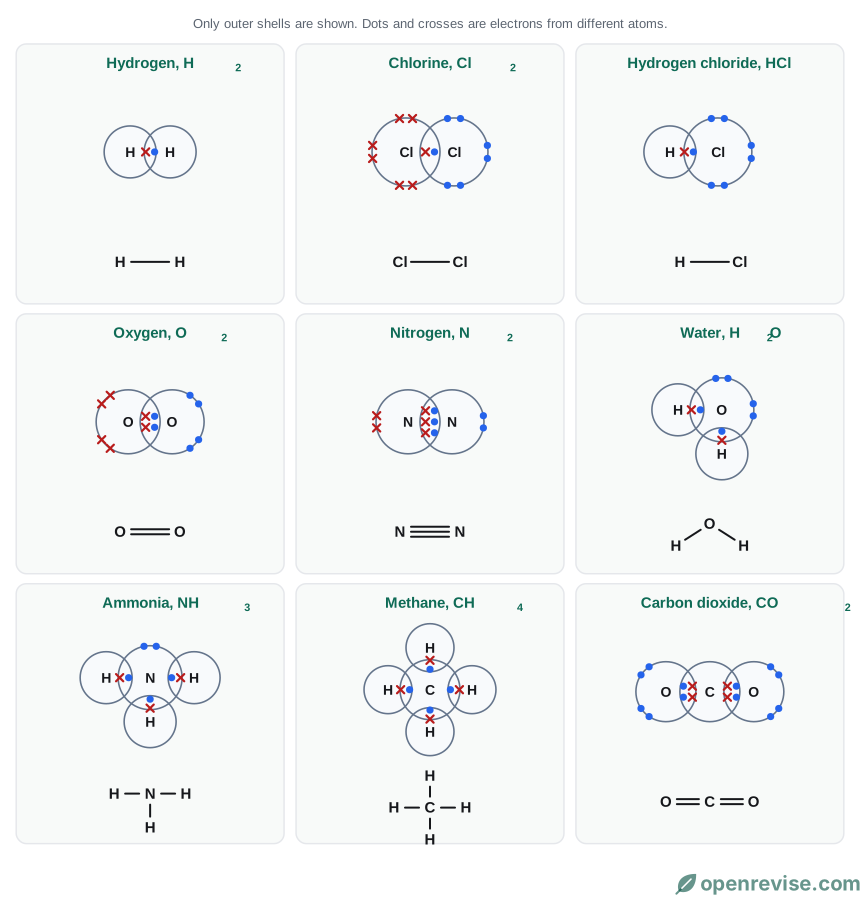
Drawing tips:
- Put each shared pair in the overlap of the two circles, one dot and one cross.
- Count the electrons around each atom: hydrogen should have 2 and the others 8.
- Pairs of outer electrons that are not shared are called lone pairs.
Representing molecules
| Representation | Shows | Limitation |
|---|---|---|
| Molecular formula, e.g. NH3 | the number of each type of atom | does not show the bonds or the shape |
| Dot and cross diagram | which atom each electron came from | does not show the 3D shape; electrons are really all identical |
| Displayed formula | every covalent bond as a line | does not show the 3D shape or the electrons |
| Ball and stick model | the 3D shape and bond angles | bonds are not sticks; atoms are not to scale and gaps are too big |
Size
Atoms and simple molecules are tiny. An atom has a radius of about 0.1 nm (1 × 10⁻¹⁰ m), and small molecules are about 10-10 to 10-9 m across.
Test yourself on this lesson
6 exam questions · 10 marks · with mark schemes and model answers
Found a mistake?