2.4 Metallic bonding and the properties of metals
Metallic bonding as positive ions in a sea of delocalised electrons, how it explains the high melting points, conductivity and malleability of metals, and why alloys are harder than pure metals.
Metallic bonding
Key terms
- Delocalised electrons: electrons that are not attached to one atom and are free to move through the whole structure.
- Metallic bond: the strong electrostatic attraction between positive metal ions and the delocalised electrons.
- Alloy: a mixture of a metal with at least one other element, usually another metal.
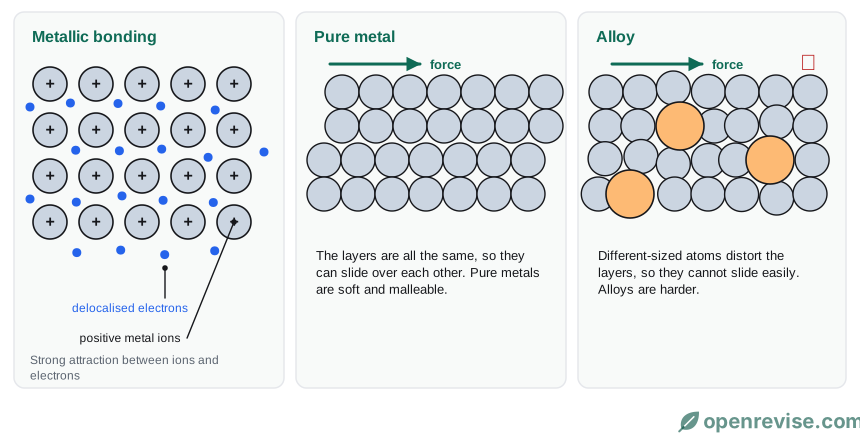
Metals have a giant structure of atoms arranged in a regular pattern of layers. The outer electrons of the metal atoms are delocalised, so the structure is a lattice of positive ions in a "sea" of electrons. The ions and the electrons attract each other strongly.
Properties of metals
| Property | Explanation |
|---|---|
| High melting and boiling points | the metallic bonds are strong, so a lot of energy is needed to overcome them |
| Good conductors of electricity | the delocalised electrons can move through the structure and carry charge |
| Good conductors of heat | the delocalised electrons transfer energy through the metal |
| Malleable and ductile | the layers of ions can slide over each other without the bonding breaking |
Most metals are also shiny and have a high density.
Alloys
Pure metals such as iron, copper and gold are often too soft for everyday use. Mixing in atoms of other elements makes an alloy.
The added atoms are a different size. They distort the layers, so it is much harder for the layers to slide over each other. This makes alloys harder and stronger than pure metals.
Examples:
- steel: iron with carbon (and sometimes other metals)
- brass: copper and zinc
- bronze: copper and tin
- jewellery gold: gold with copper and silver
Test yourself on this lesson
5 exam questions · 10 marks · with mark schemes and model answers
Found a mistake?