2.2 Ionic compounds and their formulae
The structure of ionic compounds as giant lattices held by strong electrostatic forces, the strengths and limitations of lattice models, working out formulae from the charges on ions, and the -ide and -ate endings.
Giant ionic lattices
Key terms
- Giant ionic lattice: a regular three-dimensional arrangement of oppositely charged ions, held together by strong electrostatic forces acting in all directions.
An ionic compound is a giant structure of ions. In sodium chloride, each \mathrm{Na^+} ion is surrounded by six \mathrm{Cl^-} ions, and each \mathrm{Cl^-} ion by six \mathrm{Na^+} ions. The pattern repeats in all directions.
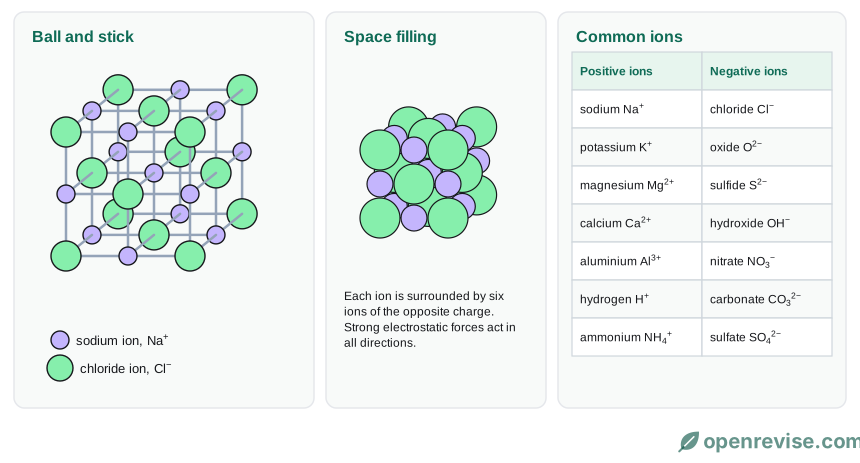
| Model | Useful because | Limitation |
|---|---|---|
| Ball and stick | shows the 3D arrangement of the ions clearly | the ions are not joined by sticks, and the gaps are far too big |
| Space filling | shows the ions touching, with their relative sizes | hard to see the ions inside the structure |
| 2D diagram | quick to draw | does not show the 3D arrangement |
All of these show only a tiny part of the lattice. A real crystal contains billions of ions.
Working out formulae
An ionic compound has no overall charge: the total positive charge equals the total negative charge.
- Write down the ions and their charges.
- Use enough of each ion to make the charges cancel.
- Put brackets around a compound ion if you need more than one of it.
Examples:
- sodium oxide: \mathrm{Na^+} and \mathrm{O^{2-}} → two \mathrm{Na^+} for each \mathrm{O^{2-}} → Na2O
- aluminium oxide: \mathrm{Al^{3+}} and \mathrm{O^{2-}} → 2 × (3+) = 6+ and 3 × (2−) = 6− → Al2O3
- calcium hydroxide: \mathrm{Ca^{2+}} and \mathrm{OH^-} → Ca(OH)2
- ammonium sulfate: \mathrm{NH_4^+} and \mathrm{SO_4^{2-}} → (NH4)2SO4
Naming: -ide and -ate
- -ide: the compound contains just the two elements named, e.g. sodium chloride (NaCl), magnesium oxide (MgO). Hydroxide is an exception.
- -ate: the negative ion also contains oxygen, e.g. copper sulfate (CuSO4), sodium nitrate (NaNO3), calcium carbonate (CaCO3).
Test yourself on this lesson
6 exam questions · 10 marks · with mark schemes and model answers
Found a mistake?