2.5 States of matter and the particle model
The arrangement, movement and energy of particles in solids, liquids and gases, the names of changes of state, predicting states from melting and boiling points, state symbols, and the limitations of the particle model.
The three states
Key terms
- Particle model: a model in which all substances are made of tiny particles, shown as small solid spheres.
- Physical change: a change, such as a change of state, in which no new substance is made. It is easily reversed.
| State | Arrangement | Movement | Energy |
|---|---|---|---|
| Solid | regular pattern, touching | vibrate about fixed positions | lowest |
| Liquid | random, still touching | move around each other | more |
| Gas | random, far apart | move quickly in all directions | highest |
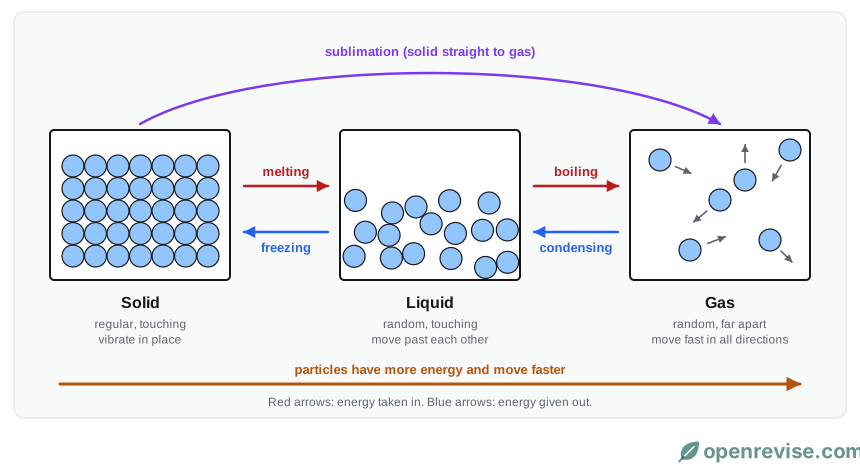
Changes of state
- melting: solid → liquid
- freezing: liquid → solid
- boiling or evaporating: liquid → gas (evaporation happens only at the surface, below the boiling point)
- condensing: gas → liquid
- sublimation: solid → gas, without becoming a liquid (for example, solid carbon dioxide)
When a substance melts or boils, energy is transferred to the particles. The forces between them are overcome, so they can move more freely. When it condenses or freezes, energy is given out and forces form between the particles.
The stronger the forces between the particles, the higher the melting point and boiling point. The strength of these forces depends on the type of bonding and structure.
These are physical changes: no new substances are made and the change can be reversed. In a chemical change, new substances form.
Predicting the state
At a given temperature, a substance is:
- a solid if the temperature is below its melting point
- a liquid if the temperature is between its melting point and boiling point
- a gas if the temperature is above its boiling point
Example: bromine melts at −7 °C and boils at 59 °C. At 25 °C it is a liquid.
State symbols
(s) solid, (l) liquid, (g) gas and (aq) aqueous (dissolved in water). For example: Mg(s) + 2HCl(aq) → MgCl2(aq) + H2(g)
Limitations of the particle model
- Particles are shown as solid spheres, but atoms are mostly empty space.
- No forces between the particles are shown.
- All particles are drawn the same size and shape, but real particles are not.
Test yourself on this lesson
6 exam questions · 11 marks · with mark schemes and model answers
Found a mistake?