2.6 Properties of ionic compounds
Why ionic compounds have high melting and boiling points, why they conduct electricity when molten or dissolved but not when solid, and how these properties come from their giant ionic lattice structure.
High melting and boiling points
Key terms
- Electrostatic force: the force of attraction between oppositely charged particles.
Ionic compounds have a giant ionic lattice structure. There are strong electrostatic forces of attraction between the oppositely charged ions, acting in all directions. A lot of energy is needed to overcome these forces, so ionic compounds have high melting and boiling points. They are all solids at room temperature.
The greater the charges on the ions, the stronger the forces. Magnesium oxide (\mathrm{Mg^{2+}} and \mathrm{O^{2-}}) melts at 2852 °C, much higher than sodium chloride (\mathrm{Na^+} and \mathrm{Cl^-}) at 801 °C.
Conducting electricity
For a substance to conduct electricity, it must contain charged particles that are free to move.
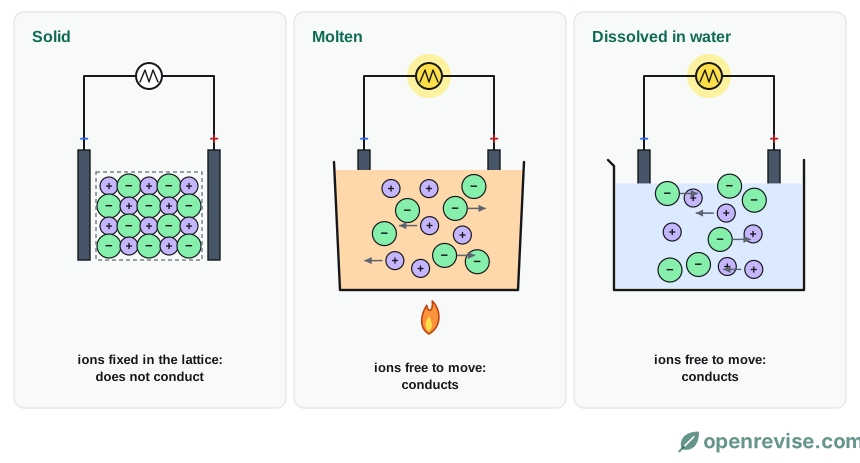
| State | Conducts? | Why |
|---|---|---|
| Solid | no | the ions are held in fixed positions in the lattice and cannot move |
| Molten (liquid) | yes | the lattice has broken down and the ions are free to move |
| Dissolved in water | yes | the ions separate and are free to move through the solution |
When an ionic compound conducts, the positive ions move towards the negative electrode and the negative ions move towards the positive electrode. This is the basis of electrolysis.
Other properties
- Many ionic compounds dissolve in water.
- They are hard but brittle: if a layer is pushed, ions with the same charge line up and repel, so the crystal shatters.
Test yourself on this lesson
5 exam questions · 11 marks · with mark schemes and model answers
Found a mistake?