8.1 Pure substances and formulations
What pure means in chemistry compared with everyday use, how melting and boiling points show whether a substance is pure, and what formulations are, with examples such as paints, medicines and fertilisers.
What does pure mean?
Key terms
- Pure substance: a single element or a single compound, not mixed with any other substance.
- Formulation: a mixture that has been designed as a useful product, with each component in a carefully measured quantity.
In everyday language, "pure" means natural or with nothing added. "Pure orange juice" is actually a mixture of water, sugars, acids and other substances.
In chemistry, a pure substance contains only one element or compound.
Testing purity with melting and boiling points
- A pure substance melts and boils at a specific, sharp temperature. Pure water melts at 0 °C and boils at 100 °C.
- An impure substance (a mixture) melts and boils over a range of temperatures. Impurities usually lower the melting point and raise the boiling point.
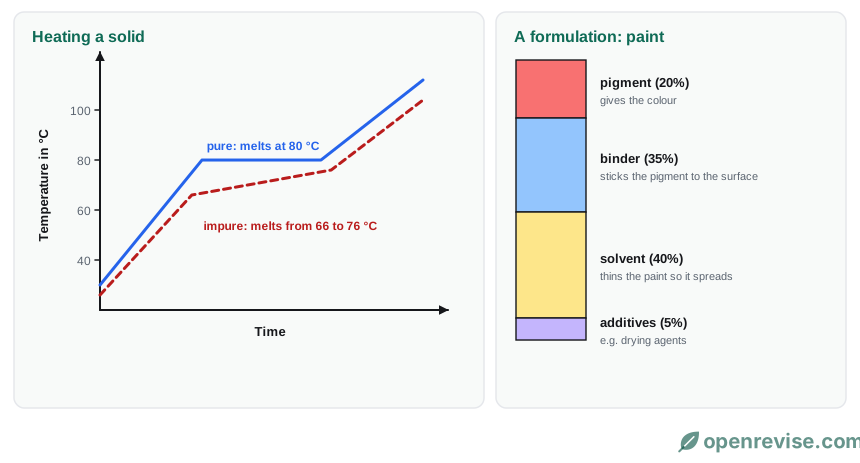
You can compare the measured melting point with the value in a data book. The closer and sharper the value, the purer the sample.
Formulations
A formulation is a mixture made by following a formula (a recipe). Each component has a particular purpose, and the quantities are measured precisely so the product works properly.
| Formulation | Components |
|---|---|
| paint | pigment, binder, solvent, additives |
| medicine tablet | active ingredient, fillers, binder, coating |
| fertiliser | compounds of nitrogen, phosphorus and potassium in set proportions |
| fuels, cleaning agents, alloys, foods | carefully measured mixtures |
Test yourself on this lesson
5 exam questions · 8 marks · with mark schemes and model answers
Found a mistake?