7.13 Natural polymers: proteins, DNA, starch and cellulose
How amino acids join by condensation polymerisation to form proteins, the structure of DNA as two polymer chains of nucleotides in a double helix with four bases, and how starch and cellulose are polymers of glucose.
Polymers in living things
Key terms
- Amino acid: a monomer with two different functional groups, an amine group (–NH2) and a carboxylic acid group (–COOH), which joins to make proteins.
- Nucleotide: the monomer of DNA, containing a sugar, a phosphate and one of four bases.
Many important molecules in living things are natural polymers.
| Polymer | Monomer | Function |
|---|---|---|
| protein | amino acids | enzymes, muscle, hormones |
| DNA | nucleotides | carries genetic information |
| starch | glucose | energy store in plants |
| cellulose | glucose | strengthens plant cell walls |
Proteins (Higher for AQA)
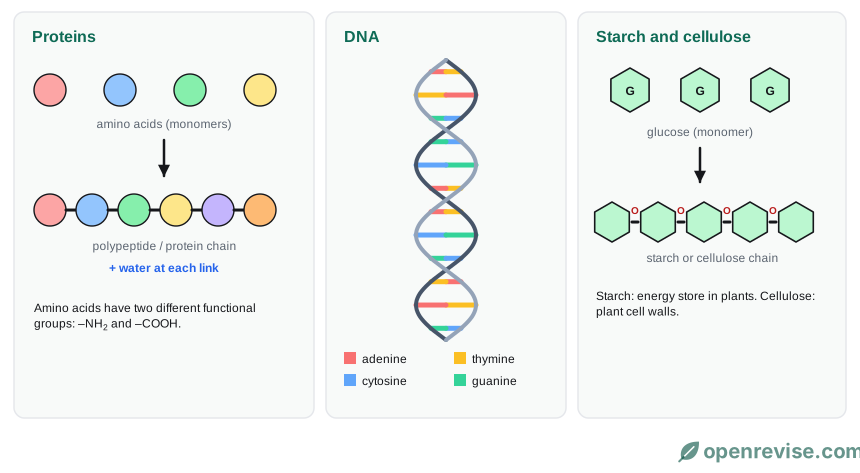
Amino acids have two different functional groups: an amine group and a carboxylic acid group. The –COOH group of one amino acid reacts with the –NH2 group of the next, and a molecule of water is lost. This is condensation polymerisation.
The simplest amino acid is glycine, H2NCH2COOH. Many amino acids join to form a polypeptide; one or more polypeptides make a protein. There are about 20 different amino acids, so there are a huge number of different proteins.
DNA
DNA (deoxyribonucleic acid) is a large molecule that carries the genetic instructions for living organisms and viruses.
- It is made of two polymer chains, twisted to form a double helix.
- The monomers are nucleotides.
- There are four different bases: A, T, C and G. They pair up between the two chains: A with T, and C with G.
Starch and cellulose
Both are polymers of glucose, a sugar. The glucose units are joined in a different way:
- starch is the energy store in plants, and is broken down into glucose for respiration
- cellulose forms strong fibres in plant cell walls
Test yourself on this lesson
5 exam questions · 10 marks · with mark schemes and model answers
Found a mistake?