4.9 Strong and weak acids
The difference between strong and weak acids (full or partial ionisation), the difference between concentrated and dilute, and how pH changes by one unit for each factor of 10 change in hydrogen ion concentration.
Strength: how much the acid ionises
Key terms
- Strong acid: an acid that is completely ionised in aqueous solution, such as hydrochloric, nitric and sulfuric acids.
- Weak acid: an acid that is only partially ionised in aqueous solution, such as ethanoic, citric and carbonic acids.
- Strong: HCl(aq) → \mathrm{H^+}(aq) + \mathrm{Cl^-}(aq) (every molecule ionises)
- Weak: CH3COOH(aq) ⇌ \mathrm{H^+}(aq) + \mathrm{CH_3COO^-}(aq) (a reversible reaction; only a few molecules ionise at any moment)
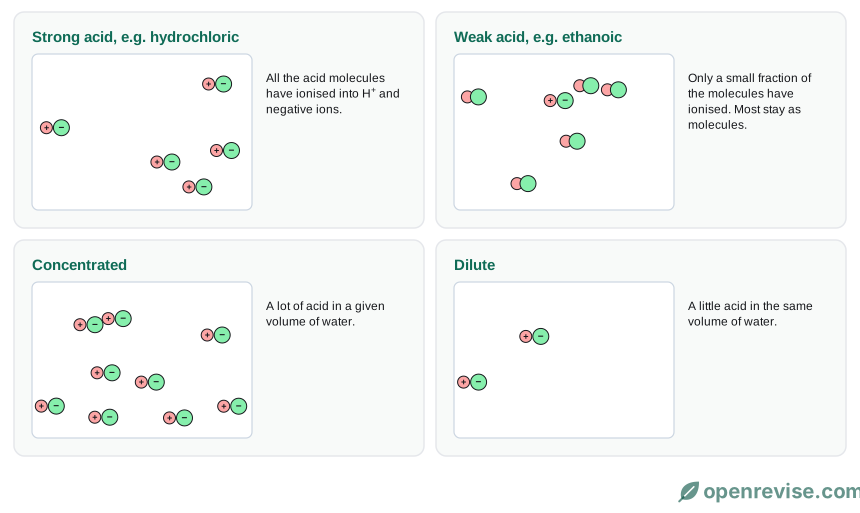
Concentration: how much acid is dissolved
Key terms
- Concentrated: a large amount of solute (acid) in a given volume of solution.
- Dilute: a small amount of solute in a given volume of solution.
Strength and concentration are different things. You can have a dilute solution of a strong acid, or a concentrated solution of a weak acid.
Comparing acids of the same concentration
A strong acid has a higher concentration of \mathrm{H^+} ions than a weak acid of the same concentration. So the strong acid:
- has a lower pH
- reacts faster with metals and carbonates (more \mathrm{H^+} ions to collide with)
pH and hydrogen ion concentration
The pH scale is a measure of the concentration of \mathrm{H^+} ions.
- As the \mathrm{H^+} concentration increases by a factor of 10, the pH decreases by 1.
- So a solution of pH 2 has 10 times the \mathrm{H^+} concentration of a solution of pH 3, and 100 times that of a solution of pH 4.
Example: an acid is diluted so its \mathrm{H^+} concentration falls from 0.1 mol/dm3 to 0.001 mol/dm3. That is a factor of 100 (10 × 10), so the pH rises by 2, from 1 to 3.
Test yourself on this lesson
5 exam questions · 9 marks · with mark schemes and model answers
Found a mistake?