4.10 Solubility rules and preparing salts
The general rules for which common salts are soluble in water, predicting precipitates, and the methods for preparing a soluble salt by titration and an insoluble salt by precipitation.
Edexcel
2 min read
Solubility rules
Key terms
- Soluble: dissolves in water.
- Precipitate: an insoluble solid formed when two solutions are mixed.
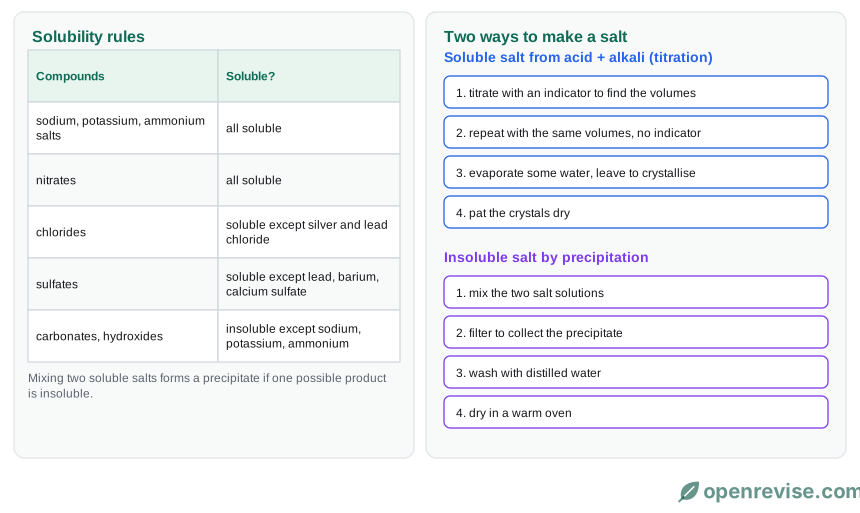
- All common sodium, potassium and ammonium salts are soluble.
- All nitrates are soluble.
- Common chlorides are soluble, except silver chloride and lead chloride.
- Common sulfates are soluble, except lead, barium and calcium sulfates.
- Common carbonates and hydroxides are insoluble, except those of sodium, potassium and ammonium.
Predicting precipitates
When two solutions are mixed, the ions swap partners. If one of the new combinations is insoluble, it forms a precipitate.
Example: barium chloride solution + sodium sulfate solution → barium sulfate + sodium chloride
BaCl2(aq) + Na2SO4(aq) → BaSO4(s) + 2NaCl(aq)
Barium sulfate is insoluble, so a white precipitate forms.
Choosing a method
| Salt wanted | Starting materials | Method |
|---|---|---|
| Soluble salt | acid + insoluble base, carbonate or metal | add excess solid, filter, crystallise |
| Soluble salt | acid + alkali (both soluble) | titration, then crystallise |
| Insoluble salt | two soluble salts | precipitation |
Soluble salt by titration (e.g. sodium chloride)
- Use a pipette to put 25.0 cm3 of alkali in a conical flask and add a few drops of indicator.
- Add acid from a burette until the indicator just changes colour. Record the volume.
- Repeat without the indicator, using the same volumes, so the salt is not contaminated.
- Evaporate some of the water and leave the solution to crystallise. Dry the crystals.
Insoluble salt by precipitation (e.g. barium sulfate)
- Mix solutions of two soluble salts, such as barium chloride and sodium sulfate.
- Filter to collect the precipitate on the filter paper.
- Wash it with distilled water to remove the soluble impurities.
- Dry it in a warm oven or on filter paper.
Test yourself on this lesson
5 exam questions · 10 marks · with mark schemes and model answers
Found a mistake?