4.1 Oxidation and reduction
Oxidation as gain of oxygen and reduction as loss of oxygen, metals reacting with oxygen to form oxides, and identifying which substance is oxidised and which is reduced in a redox reaction.
AQA
Edexcel
OCR
1 min read
Oxidation and reduction
Key terms
- Oxidation: gain of oxygen by a substance.
- Reduction: loss of oxygen from a substance.
- Redox reaction: a reaction in which oxidation and reduction both happen.
Metals reacting with oxygen
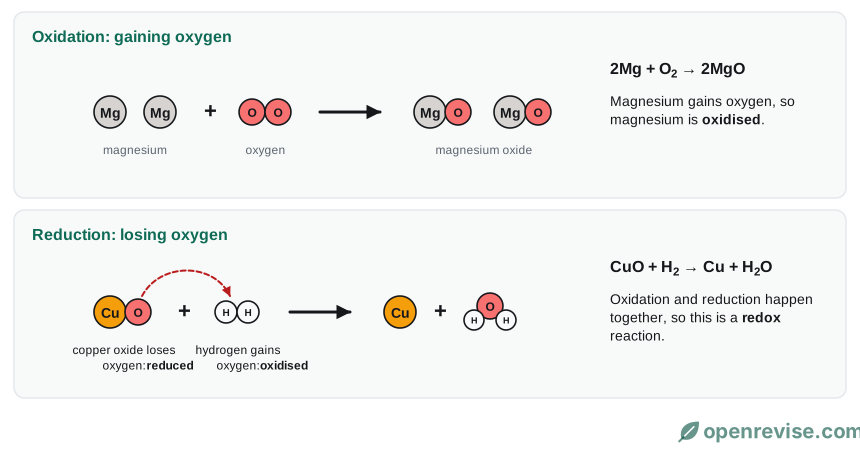
Many metals react with oxygen to form metal oxides. The metal gains oxygen, so it is oxidised.
- 2Mg + O2 → 2MgO (magnesium burns with a bright white flame)
- 4Na + O2 → 2Na2O
- 2Cu + O2 → 2CuO (copper turns black when heated in air)
Iron is oxidised slowly in air and water when it rusts.
Reduction
When oxygen is removed from a compound, the compound is reduced. This is how many metals are extracted from their oxides.
- CuO + H2 → Cu + H2O: copper oxide is reduced, hydrogen is oxidised
- 2CuO + C → 2Cu + CO2: copper oxide is reduced, carbon is oxidised
- Fe2O3 + 3CO → 2Fe + 3CO2: iron oxide is reduced, carbon monoxide is oxidised
Identifying what is oxidised and reduced
- Find the substance that gains oxygen: it is oxidised.
- Find the substance that loses oxygen: it is reduced.
The oxygen removed from one substance is gained by another, so oxidation and reduction always happen together.
| Reaction | Oxidised | Reduced |
|---|---|---|
| 2Mg + O2 → 2MgO | magnesium | oxygen |
| 2CuO + C → 2Cu + CO2 | carbon | copper oxide |
| ZnO + C → Zn + CO | carbon | zinc oxide |
Test yourself on this lesson
5 exam questions · 8 marks · with mark schemes and model answers
Found a mistake?