3.12 Volumes of gases
The volume of one mole of any gas at room temperature and pressure, how to calculate gas volumes from masses and equations, and how to use Avogadro's law to find the volumes of gases that react.
Molar volume
Key terms
- Room temperature and pressure (RTP): 20 °C and 1 atmosphere pressure.
- Molar volume: the volume of one mole of a gas. At RTP it is 24 dm3 (24 000 cm3) for any gas.
At the same temperature and pressure, one mole of any gas takes up the same volume, whatever the gas. This is because the molecules are very far apart compared with their size.
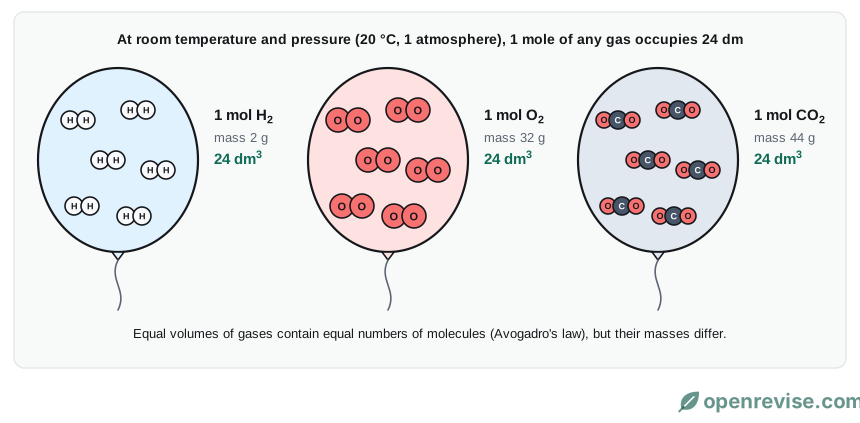
So moles of gas = volume (dm3) ÷ 24, or volume (cm3) ÷ 24 000.
Calculating gas volumes
Example 1: volume of 8.8 g of carbon dioxide (M_\mathrm{r} = 44) at RTP.
moles = 8.8 ÷ 44 = 0.20 mol, so volume = 0.20 × 24 = 4.8 dm3
Example 2: volume of carbon dioxide made when 10 g of calcium carbonate reacts with excess acid.
CaCO3 + 2HCl → CaCl2 + H2O + CO2
- moles of CaCO3 = 10 ÷ 100 = 0.10 mol
- ratio 1 : 1, so 0.10 mol of CO2
- volume = 0.10 × 24 = 2.4 dm3
Avogadro's law
Equal volumes of different gases at the same temperature and pressure contain the same number of molecules.
So for reacting gases, the ratio of volumes is the same as the ratio of moles in the equation.
Example: N2 + 3H2 → 2NH3
30 cm3 of hydrogen reacts with 10 cm3 of nitrogen to make 20 cm3 of ammonia.
Test yourself on this lesson
5 exam questions · 9 marks · with mark schemes and model answers
Found a mistake?