4.2 The reactivity series and displacement
The order of reactivity of metals including carbon and hydrogen, how metals react with water and dilute acids, displacement reactions, and how reactivity relates to the tendency of a metal to form positive ions.
The reactivity series
Key terms
- Reactivity series: a list of metals in order of how readily they react.
- Displacement reaction: a reaction in which a more reactive metal takes the place of a less reactive metal in a compound.
When metals react, their atoms lose electrons to form positive ions. The more easily a metal forms positive ions, the more reactive it is.
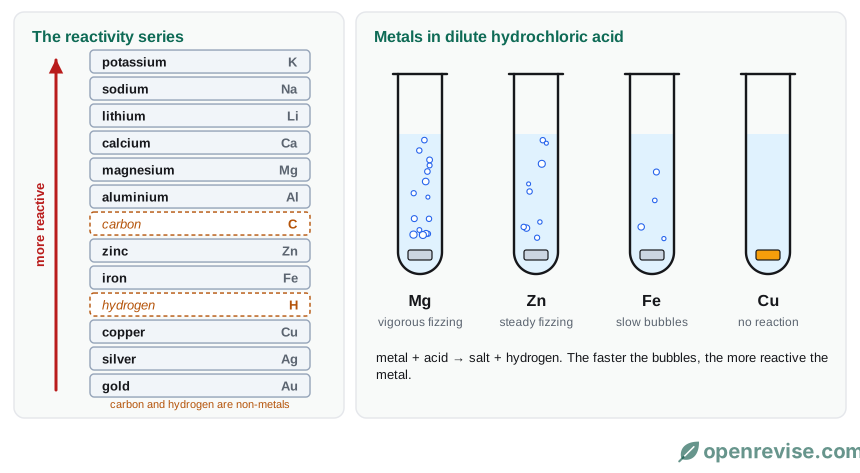
Carbon and hydrogen are non-metals, but they are included so that you can compare them with the metals.
Reactions with water and acids
| Metal | With cold water | With dilute acid |
|---|---|---|
| Potassium, sodium, lithium | fizz and form a metal hydroxide + hydrogen | dangerously violent |
| Calcium | reacts steadily | very vigorous |
| Magnesium | very slowly (reacts with steam) | vigorous fizzing |
| Zinc, iron | no reaction (react slowly with steam) | steady to slow fizzing |
| Copper, silver, gold | no reaction | no reaction |
- metal + water → metal hydroxide + hydrogen
- metal + acid → salt + hydrogen (for example, Mg + 2HCl → MgCl2 + H2)
Metals below hydrogen in the series do not react with dilute acids.
Displacement reactions
A more reactive metal displaces a less reactive metal from a solution of its salt.
- magnesium + copper sulfate → magnesium sulfate + copper: Mg + CuSO4 → MgSO4 + Cu
- iron + copper sulfate → iron sulfate + copper: Fe + CuSO4 → FeSO4 + Cu
You see the blue colour fade and a pink-brown coating of copper form on the metal. The mixture may warm up.
Copper cannot displace magnesium from magnesium sulfate, because copper is less reactive.
Deducing an order of reactivity
Add metals to solutions of each other's salts and see which react. The metal that displaces the most other metals is the most reactive. You can also compare how fast metals fizz with acid or how much the temperature rises.
Test yourself on this lesson
5 exam questions · 10 marks · with mark schemes and model answers
Found a mistake?