5.5 Chemical cells and batteries
How a simple chemical cell produces a voltage from two different metals in an electrolyte, the factors affecting the voltage, how batteries are made, and the difference between non-rechargeable and rechargeable cells.
Chemical cells
Key terms
- Chemical cell: two different metals (electrodes) in contact with an electrolyte, which produce a voltage from a chemical reaction.
- Battery: two or more cells connected together in series to give a bigger voltage.
When two different metals are placed in an electrolyte and joined by a wire, the more reactive metal gives up electrons more easily. Electrons flow through the wire from the more reactive metal to the less reactive one. This is an electric current.
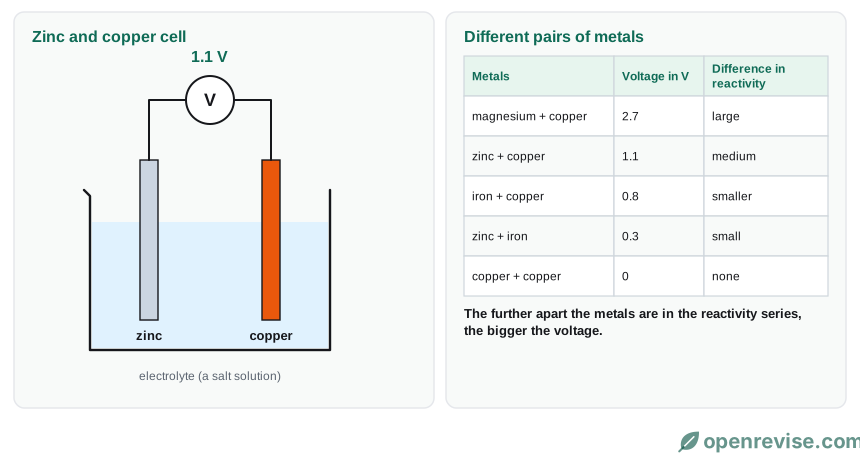
What affects the voltage?
- The two metals: the bigger the difference in reactivity, the bigger the voltage. Magnesium and copper give a bigger voltage than iron and copper.
- The electrolyte: its type and concentration.
Two pieces of the same metal give no voltage.
Batteries
A battery is several cells joined in series. The total voltage is the sum of the cell voltages: three 1.5 V cells give 4.5 V.
Non-rechargeable and rechargeable cells
- In a non-rechargeable cell, such as an alkaline battery, the chemical reaction stops when one of the reactants is used up. The cell then has to be replaced.
- In a rechargeable cell, such as a lithium-ion battery, the reactions can be reversed by connecting an external electrical supply.
| Type | Advantage | Disadvantage |
|---|---|---|
| Non-rechargeable | cheap and widely available | thrown away when used up; waste and toxic metals |
| Rechargeable | used many times, less waste | more expensive; must be recharged; lose capacity over time |
Test yourself on this lesson
5 exam questions · 8 marks · with mark schemes and model answers
Found a mistake?