5.6 Hydrogen fuel cells
How a hydrogen fuel cell uses the oxidation of hydrogen to produce a voltage, its half equations, and the advantages and disadvantages of hydrogen fuel cells compared with rechargeable batteries.
How a fuel cell works
Key terms
- Fuel cell: a cell that is supplied with a fuel and oxygen, and uses the energy released by their reaction to produce electricity.
In a hydrogen fuel cell, hydrogen is oxidised to produce a voltage. The only product is water:
hydrogen + oxygen → water: 2H2 + O2 → 2H2O
Unlike burning, the energy is released as electrical energy rather than heat. The fuel cell keeps working as long as hydrogen and oxygen are supplied.
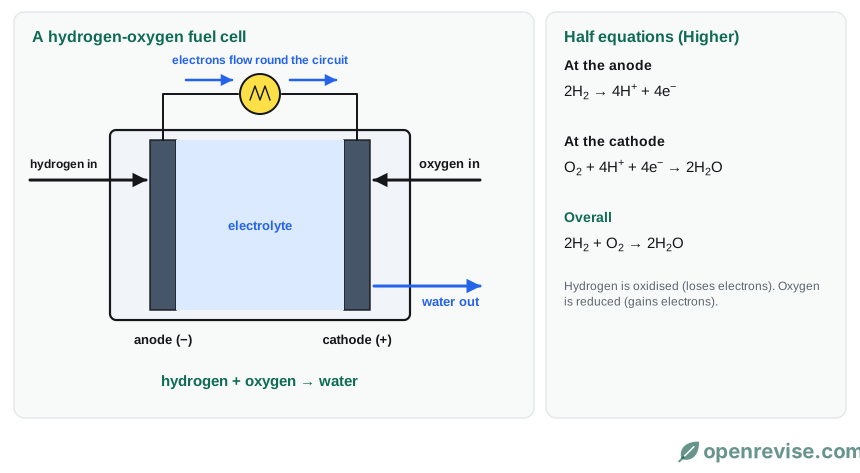
Half equations (Higher, AQA)
- At the anode: 2H2 → 4\mathrm{H^+} + 4\mathrm{e^-} (hydrogen loses electrons: oxidation)
- At the cathode: O2 + 4\mathrm{H^+} + 4\mathrm{e^-} → 2H2O (oxygen gains electrons: reduction)
The electrons flow through the external circuit from the anode to the cathode, powering a device such as a motor.
Fuel cells or rechargeable batteries?
| Fuel cells: advantages | Fuel cells: disadvantages |
|---|---|
| only product is water, so no pollution where used | hydrogen is a gas: hard to store, needs high pressure and large tanks |
| do not need recharging; refuelled quickly | hydrogen is flammable and explosive |
| can run as long as fuel is supplied | hydrogen is often made from fossil fuels, or by electrolysis that uses electricity |
| fewer parts and less toxic waste than batteries | fuel cells are expensive and there are few refuelling stations |
Rechargeable batteries are easier to store and use safely, but they take a long time to recharge, store less energy for their mass, and contain toxic metals that are difficult to dispose of.
Test yourself on this lesson
5 exam questions · 8 marks · with mark schemes and model answers
Found a mistake?