5.4 Bond energy calculations
How to use bond energies to calculate the overall energy change of a reaction, why the answer is negative for exothermic reactions and positive for endothermic reactions, and worked examples.
Higher only
AQA
Edexcel
OCR
1 min read
Bond energies
Key terms
- Bond energy: the energy needed to break one mole of a particular covalent bond, measured in kJ/mol.
- Breaking bonds takes in energy (endothermic).
- Making bonds releases the same amount of energy (exothermic).
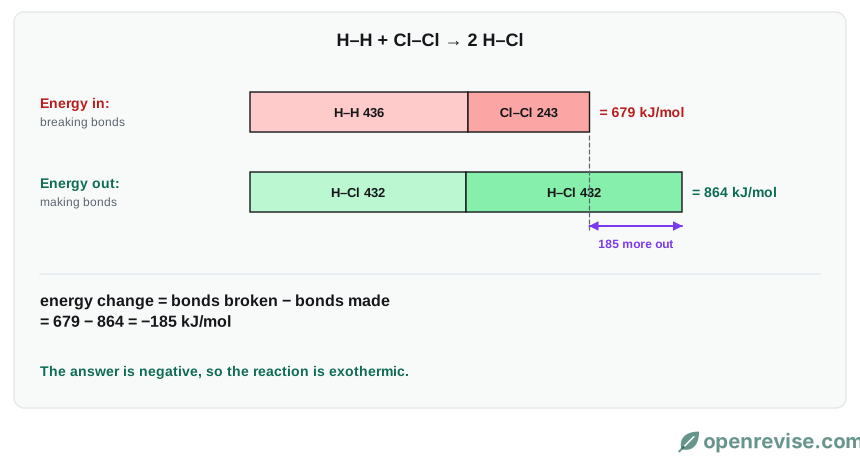
energy change = sum of bonds broken − sum of bonds made
- A negative answer means the reaction is exothermic.
- A positive answer means the reaction is endothermic.
Method
- Draw the displayed formula of every molecule so you can count the bonds.
- Add up the energy needed to break all the bonds in the reactants.
- Add up the energy released making all the bonds in the products.
- Subtract: bonds broken − bonds made.
Example: hydrogen + chlorine
H2 + Cl2 → 2HCl (bond energies: H–H 436, Cl–Cl 243, H–Cl 432 kJ/mol)
- broken: 436 + 243 = 679 kJ/mol
- made: 2 × 432 = 864 kJ/mol
- energy change = 679 − 864 = −185 kJ/mol (exothermic)
Example: burning methane
CH4 + 2O2 → CO2 + 2H2O (C–H 413, O=O 498, C=O 805, O–H 464 kJ/mol)
- broken: (4 × 413) + (2 × 498) = 1652 + 996 = 2648 kJ/mol
- made: (2 × 805) + (4 × 464) = 1610 + 1856 = 3466 kJ/mol
- energy change = 2648 − 3466 = −818 kJ/mol
| Bond | Bond energy in kJ/mol |
|---|---|
| H–H | 436 |
| Cl–Cl | 243 |
| H–Cl | 432 |
| C–H | 413 |
| O=O | 498 |
| C=O | 805 |
| O–H | 464 |
Test yourself on this lesson
5 exam questions · 12 marks · with mark schemes and model answers
Found a mistake?