6.1 Measuring the rate of reaction
How to measure the rate of a reaction from the amount of reactant used or product formed over time, using gas volume, loss of mass or a colour change, how to calculate a mean rate, and (Higher) how to find the rate at a moment from the gradient of a tangent.
What rate means
Key terms
- Rate of reaction: how quickly reactants are used up or products are made.
- Mean rate: the average rate over a period of time.
- Tangent: a straight line that touches a curve at one point, with the same gradient as the curve there.
The quantity can be a mass in grams or a volume in cm3, so the units of rate are g/s or cm3/s. At Higher tier it can also be an amount in moles, giving mol/s.
Ways to measure it
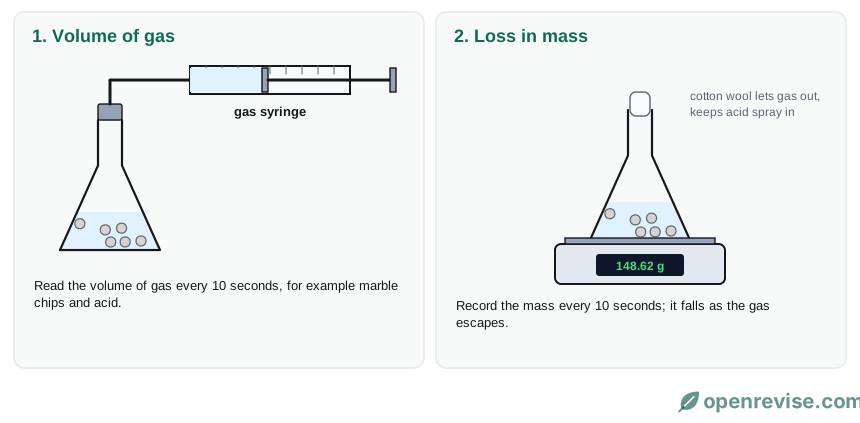
- Volume of gas given off: collect it in a gas syringe (or an upturned measuring cylinder full of water) and read the volume at regular intervals.
- Loss in mass: put the flask on a balance with a cotton wool plug. As the gas escapes, the mass falls.
- Colour change or precipitate: time how long it takes for a cross under the flask to disappear as a cloudy precipitate forms (sodium thiosulfate and acid), or for a colour to change.
Reading rate graphs
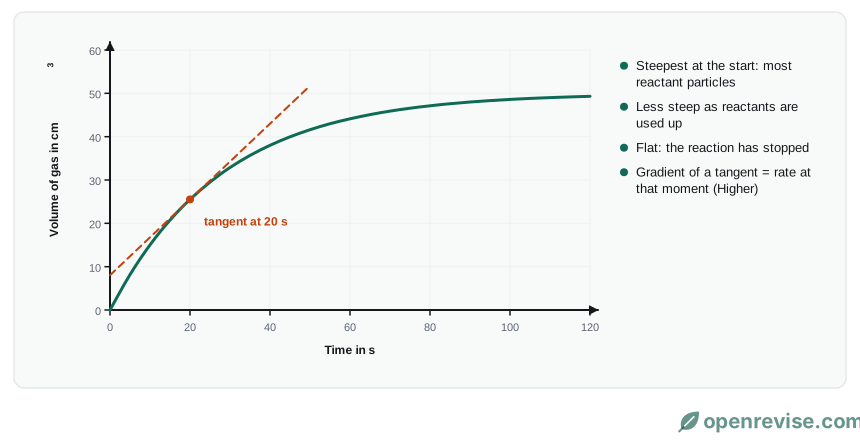
- The graph is steepest at the start, when there are the most reactant particles, so the rate is fastest.
- It gets less steep as reactants are used up.
- It becomes flat when one reactant has run out: the reaction has stopped.
- A steeper line means a faster reaction.
Example: 30 cm3 of gas is made in the first 20 s. Mean rate = 30 ÷ 20 = 1.5 cm3/s.
Rate at a particular moment (Higher)
Draw a tangent to the curve at that time and calculate its gradient: change in y ÷ change in x. On a steep part of the curve the tangent is steep, so the rate is high.
Test yourself on this lesson
6 exam questions · 12 marks · with mark schemes and model answers
Found a mistake?