7.7 Alcohols
The -OH functional group, the names and formulae of methanol to butanol, the properties, reactions and uses of alcohols, and making ethanol by fermentation and concentrating it by fractional distillation.
Separate only
AQA
Edexcel
OCR
1 min read
The alcohols
Key terms
- Alcohol: an organic compound containing the functional group –OH (hydroxyl).
Alcohols form a homologous series. Their names end in -ol.
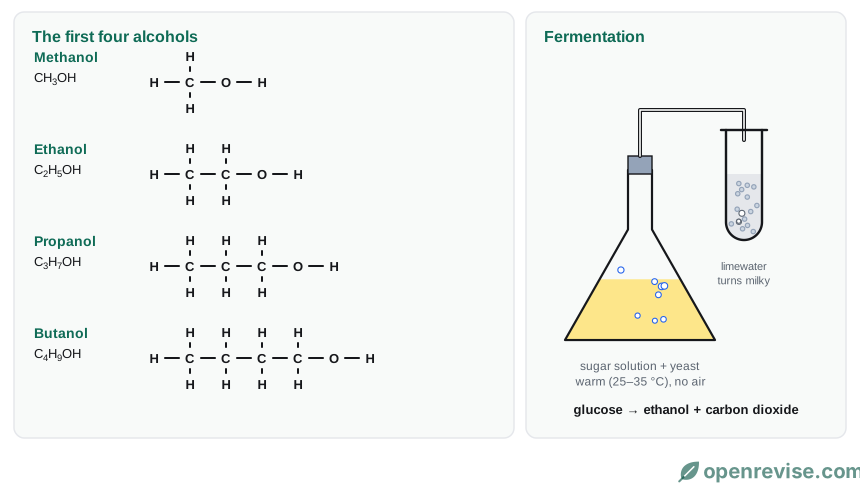
| Name | Formula |
|---|---|
| methanol | CH3OH |
| ethanol | C2H5OH |
| propanol | C3H7OH |
| butanol | C4H9OH |
Properties and reactions
- Dissolve in water to form neutral solutions (the smaller alcohols mix completely).
- Burn in air: ethanol + oxygen → carbon dioxide + water. C2H5OH + 3O2 → 2CO2 + 3H2O
- React with sodium: fizzing, giving hydrogen (more slowly than water does).
- Are oxidised by oxidising agents (such as acidified potassium dichromate) or by microbes in the air to form carboxylic acids: ethanol → ethanoic acid. This is why wine left open turns to vinegar.
Uses
- Fuels, such as ethanol mixed with petrol, and methanol
- Solvents, for example in perfumes and hand gels
- Ethanol is the alcohol in alcoholic drinks
Making ethanol by fermentation
glucose → ethanol + carbon dioxide: C6H12O6 → 2C2H5OH + 2CO2
- Yeast provides the enzymes.
- Temperature about 25–35 °C: too cold and it is slow; too hot and the enzymes are denatured.
- No air (anaerobic), otherwise the ethanol is oxidised to ethanoic acid. An air lock lets carbon dioxide out but keeps air out.
Fermentation stops at about 15% ethanol, because the ethanol kills the yeast. A concentrated solution of ethanol is obtained by fractional distillation: ethanol (boiling point 78 °C) evaporates before water (100 °C).
Test yourself on this lesson
6 exam questions · 10 marks · with mark schemes and model answers
Found a mistake?