7.6 Alkenes and their reactions
The alkenes as unsaturated hydrocarbons with a C=C double bond and the general formula CnH2n, the first four alkenes, their addition reactions with hydrogen, water and halogens, the bromine water test and their combustion.
Alkenes
Key terms
- Alkene: a hydrocarbon containing a carbon–carbon double bond, C=C. General formula \mathrm{C_nH_{2n}}.
- Unsaturated: containing a C=C double bond, so more atoms can be added.
- Functional group: the group of atoms that determines how a compound reacts. For alkenes it is C=C.
Alkenes have two fewer hydrogen atoms than the alkane with the same number of carbon atoms.
| Name | Formula |
|---|---|
| ethene | C2H4 |
| propene | C3H6 |
| butene | C4H8 |
| pentene | C5H10 |
Addition reactions
The double bond opens up and atoms add across it. Only one product forms.
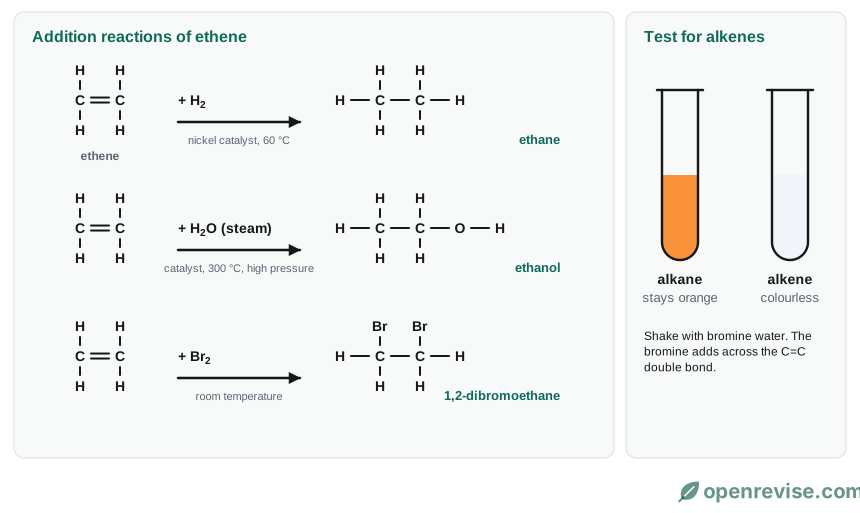
- Hydrogen (with a nickel catalyst, about 60 °C) → an alkane: C2H4 + H2 → C2H6. This is hydrogenation, used to harden vegetable oils.
- Water as steam (with a catalyst, about 300 °C and high pressure) → an alcohol: C2H4 + H2O → C2H5OH. This is how ethanol is made industrially.
- Halogens (at room temperature) → a dihaloalkane: C2H4 + Br2 → C2H4Br2
Test for alkenes
Shake with bromine water: an alkene turns it from orange to colourless; an alkane leaves it orange.
Combustion
Alkenes burn in air. They often burn with a smoky, yellow flame because combustion is incomplete: there is not enough oxygen to oxidise all the carbon. Complete combustion gives carbon dioxide and water:
C2H4 + 3O2 → 2CO2 + 2H2O
Test yourself on this lesson
6 exam questions · 10 marks · with mark schemes and model answers
Found a mistake?