7.5 Hydrogen versus petrol as a fuel
The advantages and disadvantages of using hydrogen rather than petrol as a fuel for cars, including the products of combustion, how hydrogen is produced and stored, and the availability of each fuel.
Edexcel
2 min read
Two fuels
Key terms
- Fuel: a substance that releases useful energy when it reacts, usually with oxygen.
Petrol is a mixture of hydrocarbons from crude oil. Hydrogen can be used in cars either by burning it in an engine or in a fuel cell.
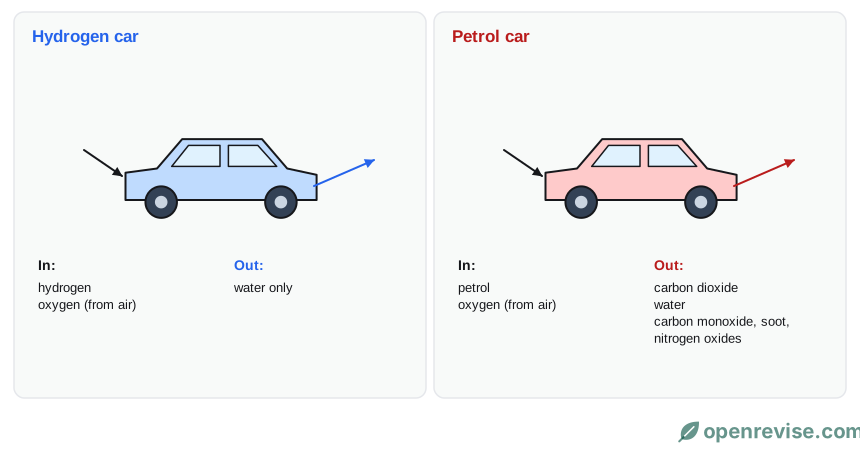
- hydrogen + oxygen → water: 2H2 + O2 → 2H2O
- petrol + oxygen → carbon dioxide + water (plus some pollutants)
Advantages of hydrogen
- The only product is water: no carbon dioxide (a greenhouse gas), no carbon monoxide or soot at the point of use.
- Hydrogen can be made from water, which is a renewable and plentiful raw material.
- It releases more energy per kilogram than petrol.
Disadvantages of hydrogen
- It is a gas, so it takes up a large volume. It must be stored at high pressure in heavy, strong tanks.
- It is highly flammable and forms explosive mixtures with air.
- Making hydrogen needs energy. It is usually made from fossil fuels (natural gas), which releases carbon dioxide, or by electrolysis of water, which needs electricity.
- There are very few refuelling stations, and hydrogen cars are expensive.
Petrol
- Easy to store and transport as a liquid, with many filling stations.
- But it comes from crude oil, a finite resource, and burning it releases carbon dioxide and pollutants such as carbon monoxide, soot and nitrogen oxides.
| Factor | Hydrogen | Petrol |
|---|---|---|
| Products | water only | CO2, H2O and pollutants |
| Source | water (or natural gas) | crude oil (finite) |
| Storage | gas under high pressure | liquid in a simple tank |
| Refuelling | very few stations | widely available |
Test yourself on this lesson
5 exam questions · 10 marks · with mark schemes and model answers
Found a mistake?