7.9 Carboxylic acids and esters
The -COOH functional group, the names and formulae of methanoic to butanoic acid, their reactions with carbonates and metals, why they are weak acids, and how esters such as ethyl ethanoate are made and used.
Carboxylic acids
Key terms
- Carboxylic acid: an organic compound containing the functional group –COOH (carboxyl).
- Ester: a compound with the functional group –COO–, made from a carboxylic acid and an alcohol.
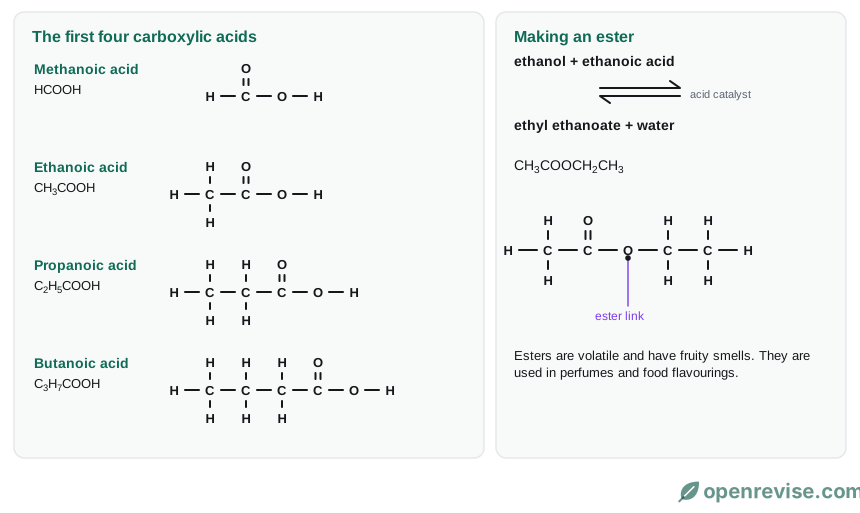
| Name | Formula |
|---|---|
| methanoic acid | HCOOH |
| ethanoic acid | CH3COOH |
| propanoic acid | C2H5COOH |
| butanoic acid | C3H7COOH |
Note that the carbon in the –COOH group is counted in the name: ethanoic acid has 2 carbon atoms.
Vinegar is a solution of ethanoic acid in water.
Reactions
Carboxylic acids dissolve in water to form acidic solutions (pH below 7). They react like other acids:
- with carbonates: fizzing, giving a salt, water and carbon dioxide ethanoic acid + sodium carbonate → sodium ethanoate + water + carbon dioxide
- with reactive metals: a salt and hydrogen
- with alcohols: an ester and water
Weak acids
Carboxylic acids are weak acids: they only partially ionise in water.
CH3COOH ⇌ \mathrm{CH_3COO^-} + \mathrm{H^+}
So a solution of ethanoic acid has a higher pH than hydrochloric acid of the same concentration, and reacts more slowly with carbonates and metals.
Esters
alcohol + carboxylic acid ⇌ ester + water
ethanol + ethanoic acid ⇌ ethyl ethanoate + water (with an acid catalyst, such as concentrated sulfuric acid)
Esters:
- are volatile (evaporate easily) and have fruity smells
- are used in perfumes and food flavourings
- ethyl ethanoate is a common solvent
Test yourself on this lesson
5 exam questions · 8 marks · with mark schemes and model answers
Found a mistake?