7.10 Addition polymerisation
How alkene monomers join by addition polymerisation, how to draw the repeating unit of a polymer and work out the monomer from it, and how the uses of common addition polymers depend on their properties.
Monomers and polymers
Key terms
- Monomer: a small molecule that can join with many others to form a polymer.
- Polymer: a very large molecule made of many repeating units joined together.
- Addition polymerisation: a reaction in which many alkene monomers join together, with the double bonds opening, to form a polymer and no other product.
In addition polymerisation, the C=C double bond in each monomer opens up and the monomers join in a long chain. The polymer is the only product.
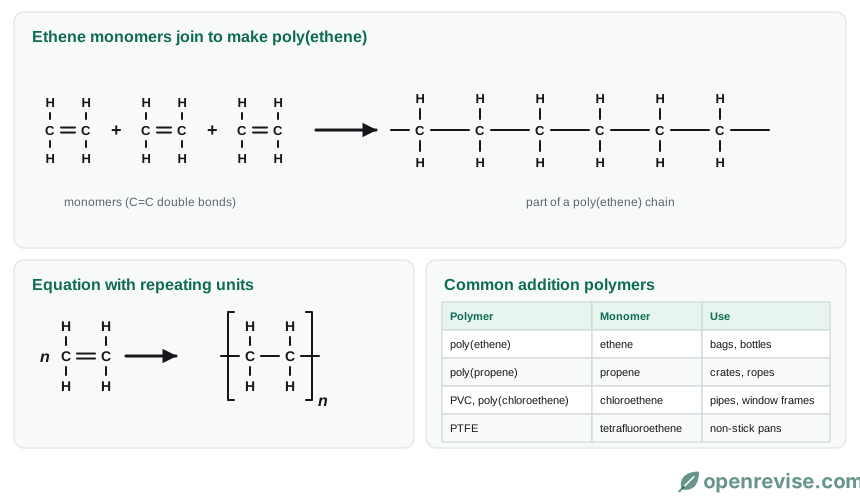
Drawing the repeating unit
- Draw the monomer with its C=C double bond.
- Change the double bond to a single bond.
- Draw a bond sticking out of each carbon, passing through brackets.
- Write n after the brackets (n is a very large number).
The repeating unit has the same atoms as the monomer: in poly(propene), each unit contains 3 carbon atoms and a CH3 side group.
Working out the monomer
Do the reverse: take the two carbons in the brackets, remove the bonds through the brackets and put a double bond between the carbons. If the repeating unit has a Cl atom, the monomer is chloroethene.
Naming
Put the monomer's name in brackets after poly: propene → poly(propene); chloroethene → poly(chloroethene) (PVC); tetrafluoroethene → poly(tetrafluoroethene) (PTFE).
Properties and uses
| Polymer | Properties | Uses |
|---|---|---|
| poly(ethene) | flexible, cheap, waterproof | plastic bags, bottles, cling film |
| poly(propene) | tough, strong, flexible | crates, ropes, carpets |
| PVC | tough, durable, can be rigid | window frames, pipes, cable insulation |
| PTFE | slippery, unreactive, heat resistant | non-stick pans, waterproof clothing |
Test yourself on this lesson
5 exam questions · 7 marks · with mark schemes and model answers
Found a mistake?