7.4 Cracking and alkenes
How long-chain hydrocarbons are cracked into shorter, more useful alkanes and alkenes by catalytic and steam cracking, why cracking is needed to match supply and demand, balancing cracking equations, and the bromine water test for alkenes.
Why crack hydrocarbons?
Key terms
- Cracking: breaking down long-chain hydrocarbons into shorter, more useful molecules.
- Alkene: an unsaturated hydrocarbon containing a carbon–carbon double bond (C=C).
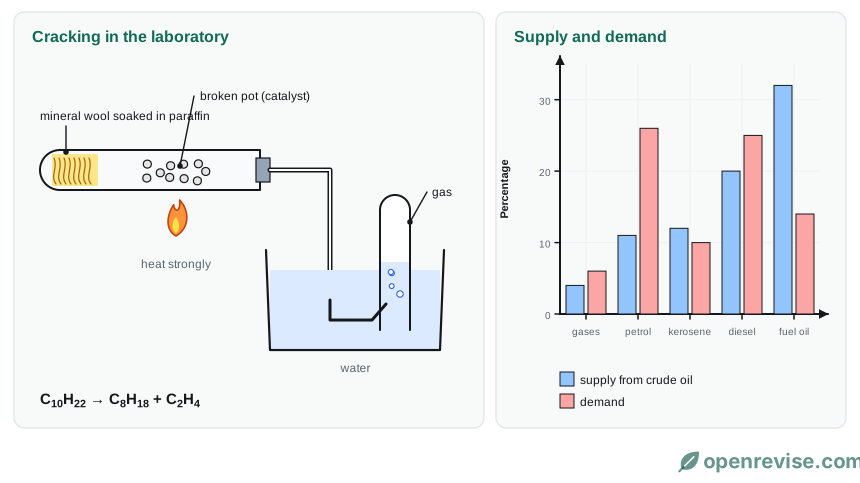
Crude oil contains more long-chain hydrocarbons than we need, and not enough short-chain ones such as petrol. Cracking turns the less useful long chains into:
- shorter alkanes, which are useful as fuels (such as petrol)
- alkenes, which are used to make polymers and other chemicals
How cracking is done
Cracking is a thermal decomposition reaction.
- Catalytic cracking: the hydrocarbon is heated to vaporise it, and the vapour is passed over a hot catalyst (such as zeolite or aluminium oxide).
- Steam cracking: the vapour is mixed with steam and heated to a very high temperature.
In the lab, paraffin is heated and the vapour is passed over hot broken pot, which acts as a catalyst. The gas is collected over water. The delivery tube must be removed from the water before you stop heating, to stop suck-back.
Cracking equations
The equation must balance: the carbon and hydrogen atoms are shared between the products.
- C10H22 → C8H18 + C2H4 (decane → octane + ethene)
- C12H26 → C8H18 + 2C2H4
To find a missing product, subtract: C14H30 → C10H22 + ? gives C4H8.
Testing for alkenes
Add bromine water and shake:
- alkene: orange → colourless (the bromine adds across the double bond)
- alkane: stays orange (no reaction)
Test yourself on this lesson
5 exam questions · 8 marks · with mark schemes and model answers
Found a mistake?