7.3 Properties and combustion of hydrocarbons
How boiling point, viscosity and flammability change with the chain length of hydrocarbons, how this affects their use as fuels, and the complete combustion of hydrocarbons with balanced equations.
AQA
Edexcel
OCR
1 min read
Properties depend on chain length
Key terms
- Viscosity: how thick a liquid is; how easily it flows.
- Flammability: how easily a substance catches fire.
As the number of carbon atoms (chain length) in a hydrocarbon increases:
- boiling point increases: bigger molecules have stronger intermolecular forces, so more energy is needed to separate them
- viscosity increases: long chains tangle and flow less easily
- flammability decreases: long-chain hydrocarbons are harder to ignite
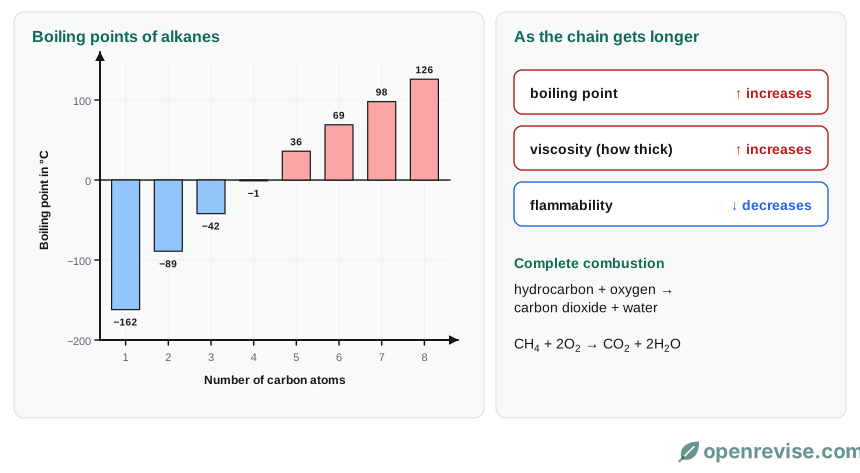
So short-chain hydrocarbons make the best fuels: they are runny, evaporate easily and catch fire easily.
| Property | Short chains (e.g. petrol) | Long chains (e.g. fuel oil) |
|---|---|---|
| Boiling point | low | high |
| Viscosity | runny | thick |
| Flammability | very flammable | hard to ignite |
Complete combustion
Key terms
- Complete combustion: burning a fuel in plenty of oxygen, so that the carbon and hydrogen are fully oxidised to carbon dioxide and water.
hydrocarbon + oxygen → carbon dioxide + water
The reaction is exothermic: it releases a lot of energy, which is why hydrocarbons are used as fuels. The carbon and hydrogen are both oxidised.
Examples:
- methane: CH4 + 2O2 → CO2 + 2H2O
- propane: C3H8 + 5O2 → 3CO2 + 4H2O
Balancing combustion equations
- Balance the carbon atoms (gives the number of CO2).
- Balance the hydrogen atoms (gives the number of H2O).
- Balance the oxygen last. If you need half an O2, double everything.
Example: 2C2H6 + 7O2 → 4CO2 + 6H2O
Test yourself on this lesson
5 exam questions · 9 marks · with mark schemes and model answers
Found a mistake?