7.1 Crude oil, hydrocarbons and alkanes
What crude oil is and how it formed, what hydrocarbons are, the alkanes as a homologous series with the general formula CnH2n+2, and the names, formulae and displayed formulae of the first four alkanes.
Crude oil
Key terms
- Crude oil: a finite resource found in rocks, made from the remains of ancient biomass, mostly plankton, buried in mud millions of years ago.
- Hydrocarbon: a compound made of hydrogen and carbon atoms only.
Crude oil is a mixture of a very large number of compounds. Most of them are hydrocarbons. It is non-renewable: it is being used up much faster than it can form.
Alkanes
Key terms
- Alkane: a saturated hydrocarbon with only single C–C bonds, general formula \mathrm{C_nH_{2n+2}}.
- Homologous series: a family of compounds with the same general formula, similar chemical properties and a gradual change in physical properties.
Most of the hydrocarbons in crude oil are alkanes. They are saturated: every carbon atom forms four single bonds, so no more atoms can be added.
Carbon atoms form four covalent bonds, and they can join to form chains and rings. This is why there are so many carbon compounds.
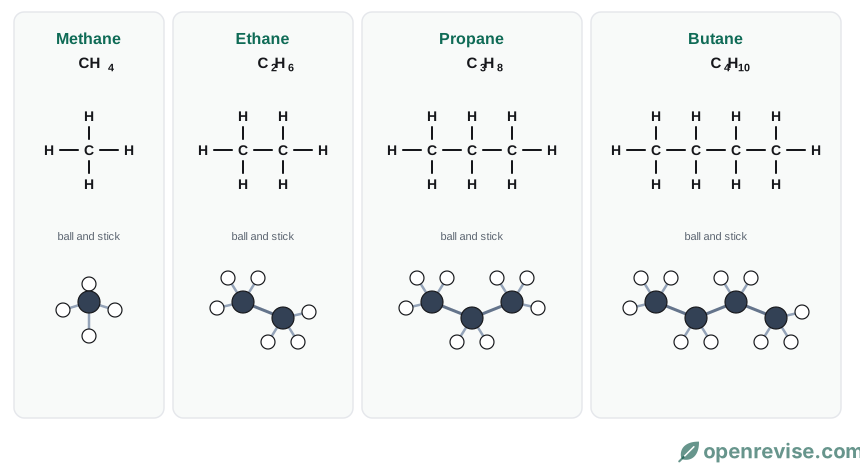
| Name | Number of carbon atoms | Molecular formula |
|---|---|---|
| methane | 1 | CH4 |
| ethane | 2 | C2H6 |
| propane | 3 | C3H8 |
| butane | 4 | C4H10 |
Each alkane differs from the next by CH2. Use the general formula to find any alkane: an alkane with 8 carbon atoms has 2 × 8 + 2 = 18 hydrogen atoms, so it is C8H18 (octane).
Members of a homologous series
- have the same general formula
- differ by CH2 from one member to the next
- have similar chemical properties (they react in the same way)
- show a gradual trend in physical properties, such as boiling point
Test yourself on this lesson
6 exam questions · 8 marks · with mark schemes and model answers
Found a mistake?