7.2 Fractional distillation of crude oil
How crude oil is separated into fractions by fractional distillation, how the temperature gradient in the column separates hydrocarbons by boiling point, and the uses of the fractions as fuels and feedstock.
AQA
Edexcel
OCR
2 min read
Separating crude oil
Key terms
- Fraction: a mixture of hydrocarbons with similar numbers of carbon atoms and similar boiling points.
- Fractional distillation: separating a mixture of liquids with different boiling points using a fractionating column.
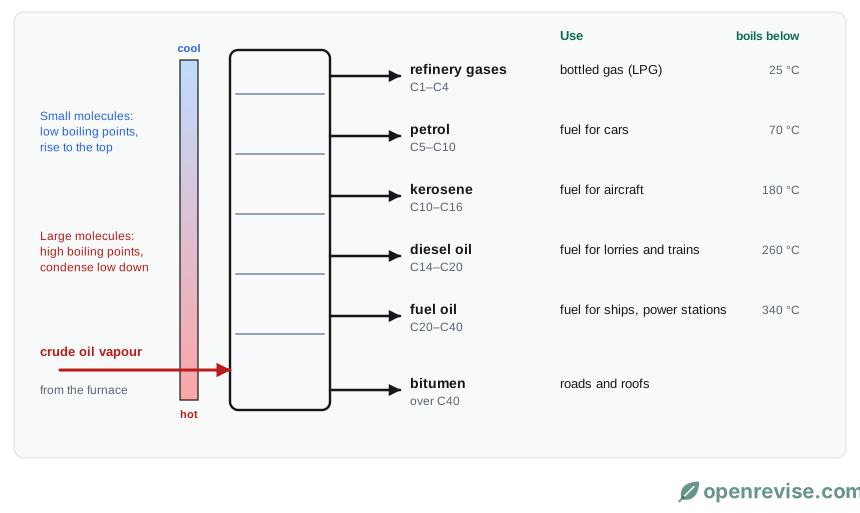
Crude oil is a mixture, so it can be separated by a physical process. The hydrocarbons are separated into fractions by fractional distillation.
How it works
- Crude oil is heated in a furnace until most of it evaporates.
- The vapour enters the bottom of a tall fractionating column.
- The column is hot at the bottom and cooler at the top (a temperature gradient).
- As the vapour rises, it cools. Each hydrocarbon condenses when it reaches a level where the temperature is below its boiling point.
- The liquids are collected on trays at different heights. Very small molecules stay as gases and leave at the top. Bitumen does not evaporate and is collected at the bottom.
Hydrocarbons with shorter chains have lower boiling points, so they are collected higher up the column.
Uses of the fractions
| Fraction | Carbon atoms | Use |
|---|---|---|
| refinery gases | 1 to 4 | bottled gas for heating and cooking |
| petrol | 5 to 10 | fuel for cars |
| kerosene | 10 to 16 | fuel for aircraft |
| diesel oil | 14 to 20 | fuel for lorries, trains and some cars |
| fuel oil | 20 to 40 | fuel for ships and some power stations |
| bitumen | over 40 | surfacing roads and roofs |
Many fractions are also used as feedstock for the petrochemical industry: they are made into solvents, lubricants, polymers, detergents and many other useful materials.
Test yourself on this lesson
5 exam questions · 10 marks · with mark schemes and model answers
Found a mistake?