6.7 Changing conditions: Le Chatelier's principle
Le Chatelier's principle: how changing concentration, temperature and pressure moves the position of equilibrium, how to predict the effect on the yield, why a catalyst does not change the position, and the Haber process as an example.
Le Chatelier's principle
Key terms
- Le Chatelier's principle: if a system at equilibrium is subjected to a change in conditions, the system responds to counteract the change.
- Position of equilibrium: the relative amounts of reactants and products at equilibrium.
- Yield: the amount of product made.
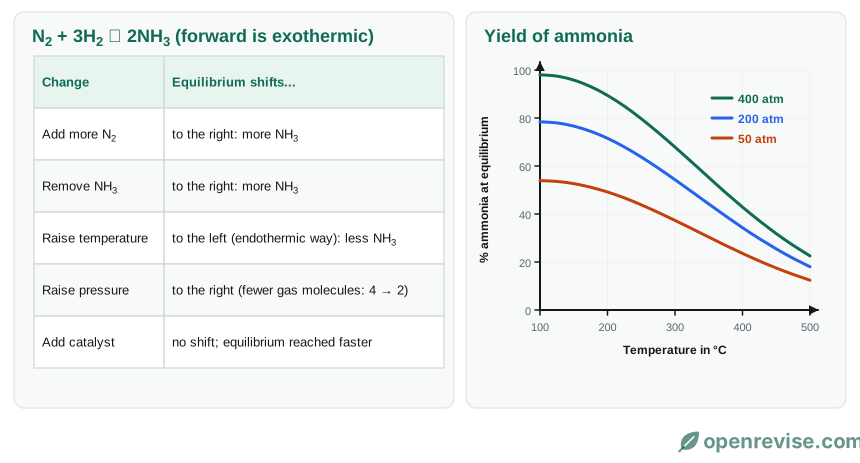
The relative amounts of all the reactants and products at equilibrium depend on the conditions. When the conditions change, the position of equilibrium shifts to oppose (counteract) the change.
Concentration
- Increasing the concentration of a reactant: more products are formed until equilibrium is reached again (shifts right).
- Removing a product: more reactants react to replace it (shifts right).
- Increasing the concentration of a product shifts it left.
Temperature
- Increasing the temperature shifts the equilibrium in the endothermic direction, to take in the extra heat.
- Decreasing the temperature shifts it in the exothermic direction.
The Haber process forward reaction is exothermic, so a lower temperature gives a higher yield of ammonia, but a slower rate.
Pressure (gas reactions)
- Increasing the pressure shifts the equilibrium towards the side with fewer molecules of gas.
- Decreasing the pressure shifts it towards the side with more molecules.
In N2 + 3H2 ⇌ 2NH3, there are 4 molecules on the left and 2 on the right, so high pressure increases the yield of ammonia. If both sides have the same number of gas molecules, pressure has no effect on the position.
Catalysts
A catalyst speeds up the forward and reverse reactions equally. It does not change the position of equilibrium or the yield, but equilibrium is reached faster.
Example: nitrogen dioxide
2NO2 (brown) ⇌ N2O4 (colourless). The forward reaction is exothermic. Heating the mixture shifts it left, so it turns darker brown; increasing the pressure shifts it right (2 → 1 molecules), so it becomes paler.
Test yourself on this lesson
6 exam questions · 13 marks · with mark schemes and model answers
Found a mistake?