7.12 Condensation polymers
How condensation polymers form from monomers with two functional groups, losing a small molecule such as water at each link, how polyesters are made from a diol and a dicarboxylic acid, and how this differs from addition polymerisation.
Condensation polymerisation
Key terms
- Condensation polymerisation: a reaction in which monomers with two functional groups join together, losing a small molecule such as water at each link.
- Polyester: a condensation polymer in which the monomers are joined by ester links.
In condensation polymerisation:
- each monomer has two functional groups, one at each end
- usually two different monomers are used
- every time two monomers join, a small molecule, usually water, is lost
- so there are two products: the polymer and water
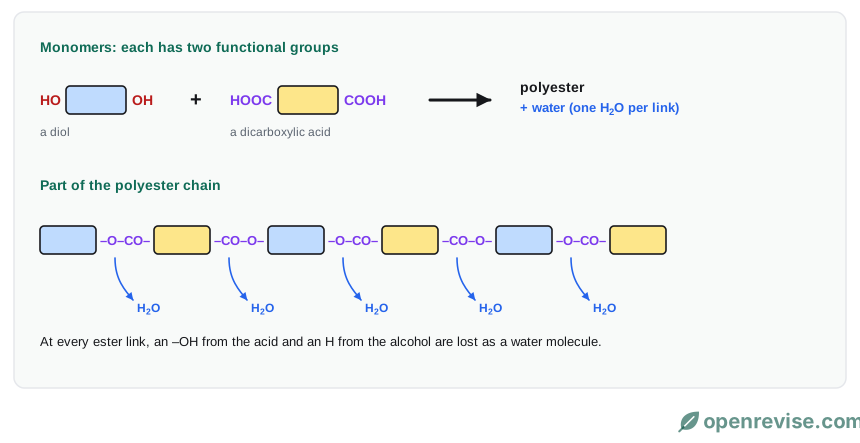
Making a polyester
- A diol has an –OH group at each end: HO–□–OH (for example ethanediol).
- A dicarboxylic acid has a –COOH group at each end: HOOC–■–COOH (for example hexanedioic acid).
The –COOH of the acid reacts with the –OH of the alcohol, just as when an ester is made. An ester link forms and water is released. Because each monomer has a group at both ends, the chain can keep growing in both directions.
n HO–□–OH + n HOOC–■–COOH → (–O–□–O–CO–■–CO–)ₙ + 2n H2O
The boxes represent the carbon chains in the monomers, which you do not need to draw in full.
Addition and condensation compared
| Feature | Addition | Condensation |
|---|---|---|
| Monomers | one type, with a C=C double bond | usually two types, each with two functional groups |
| Products | polymer only | polymer and a small molecule (e.g. water) |
| Example | poly(ethene) | polyester |
Test yourself on this lesson
5 exam questions · 8 marks · with mark schemes and model answers
Found a mistake?