3.7 Limiting reactants
What limiting reactants and reactants in excess are, how to identify the limiting reactant using moles, how it controls the mass of product, and how to use moles to balance equations.
Limiting reactants
Key terms
- Limiting reactant: the reactant that is completely used up in a reaction. It limits the amount of product that can form.
- In excess: a reactant that is left over when the reaction stops.
Chemists often use one reactant in excess to make sure that all of another (often more expensive) reactant reacts.
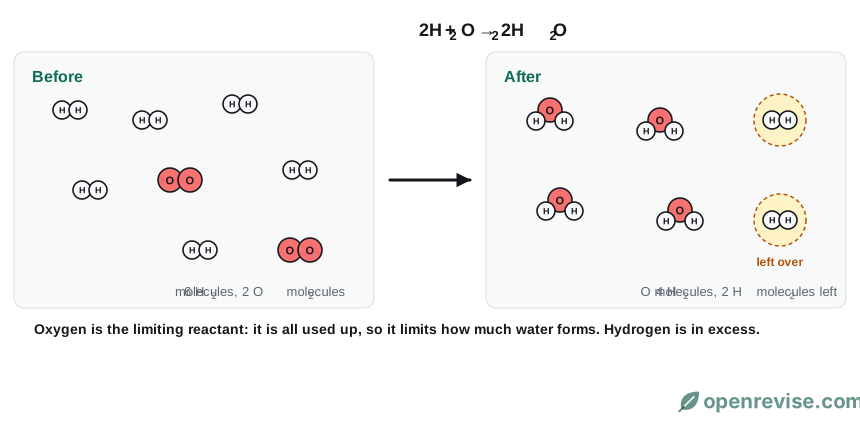
The amount of product depends on the limiting reactant. If you double the amount of the limiting reactant, you double the amount of product. Adding more of the reactant in excess makes no difference.
Finding the limiting reactant
- Work out the moles of each reactant.
- Use the ratio in the equation to see how much of one reactant is needed to react with all of the other.
- The reactant that runs out first is the limiting reactant.
- Use the moles of the limiting reactant to calculate the mass of product.
Example: 12 g of magnesium is burned in 16 g of oxygen. 2Mg + O2 → 2MgO
- Mg: 12 ÷ 24 = 0.50 mol; O2: 16 ÷ 32 = 0.50 mol
- 0.50 mol of Mg needs only 0.25 mol of O2, so oxygen is in excess and magnesium is limiting.
- MgO formed = 0.50 mol (2 : 2 ratio) = 0.50 × 40 = 20 g
Using moles to balance equations
If you know the masses that react, convert them to moles and find the simplest whole-number ratio.
Example: 2.8 g of nitrogen reacts with 0.6 g of hydrogen to make 3.4 g of ammonia.
- N2: 2.8 ÷ 28 = 0.10; H2: 0.6 ÷ 2 = 0.30; NH3: 3.4 ÷ 17 = 0.20
- divide by 0.10 → 1 : 3 : 2, so N2 + 3H2 → 2NH3
Test yourself on this lesson
5 exam questions · 12 marks · with mark schemes and model answers
Found a mistake?