3.8 Concentration of solutions in g/dm³
What concentration means, how to calculate the concentration of a solution in g/dm3 from the mass of solute and volume, converting cm3 to dm3, and how changing the mass or volume changes the concentration.
Concentration
Key terms
- Solute: the substance that dissolves (for example, salt).
- Solution: the mixture formed when a solute dissolves in a solvent (usually water).
- Concentration: the mass (or amount) of solute in a given volume of solution.
A concentrated solution has a lot of solute in a small volume. A dilute solution has a little solute in a large volume.
Converting volumes
Volumes are often measured in cm3, but concentration uses dm3:
- 1 dm3 = 1000 cm3
- to convert cm3 to dm3, divide by 1000: 250 cm3 = 0.25 dm3
Worked examples
Example 1: 5.0 g of sodium chloride is dissolved to make 250 cm3 of solution.
volume = 250 ÷ 1000 = 0.25 dm3, so concentration = 5.0 ÷ 0.25 = 20 g/dm3
Example 2: what mass of solute is in 50 cm3 of a 40 g/dm3 solution?
mass = concentration × volume = 40 × 0.050 = 2.0 g
Changing the concentration
- More solute in the same volume → higher concentration.
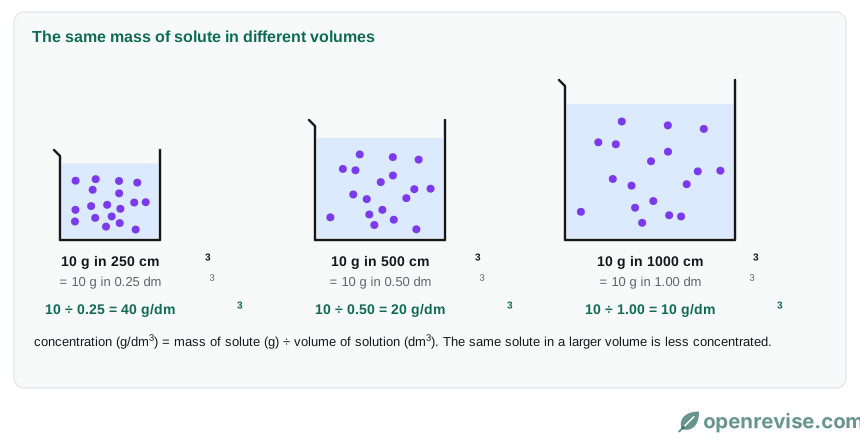
- The same mass of solute in a larger volume → lower concentration. For example, doubling the volume halves the concentration.
| To find | Use |
|---|---|
| concentration | mass ÷ volume |
| mass of solute | concentration × volume |
| volume of solution | mass ÷ concentration |
Test yourself on this lesson
5 exam questions · 9 marks · with mark schemes and model answers
Found a mistake?