3.10 Atom economy
What atom economy is, how to calculate it from a balanced equation, why a high atom economy is important for sustainable development, and how atom economy, yield, rate and other factors are used to choose a reaction pathway.
Atom economy
Key terms
- Atom economy: a measure of the amount of starting materials that end up as useful products, as a percentage.
Use the balanced equation, including the numbers in front of each formula.
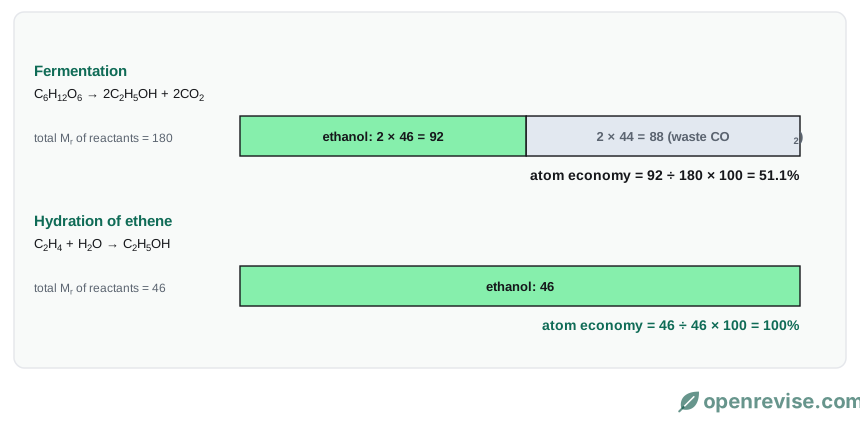
Example 1: making ethanol by fermentation: C6H12O6 → 2C2H5OH + 2CO2
- M_\mathrm{r}: glucose = 180, ethanol = 46
- atom economy = (2 × 46) ÷ 180 × 100 = 51.1%
Example 2: making ethanol by hydration of ethene: C2H4 + H2O → C2H5OH
- the only product is ethanol, so atom economy = 46 ÷ (28 + 18) × 100 = 100%
Reactions with only one product, such as addition reactions, always have an atom economy of 100%.
Why high atom economy matters
- Less waste is produced, so it is better for the environment.
- Fewer raw materials are needed, which is more sustainable and cheaper.
- A waste product may be useful and could be sold, which improves the economics of the process.
Choosing a reaction pathway
Atom economy is not the only thing that matters. Chemists also consider:
- the percentage yield
- the rate of reaction
- the position of equilibrium (for reversible reactions)
- whether any by-products are useful
- the cost and availability of raw materials and energy
For example, fermentation has a low atom economy but uses renewable sugar from plants, while hydration of ethene has 100% atom economy but uses ethene from crude oil, which is non-renewable.
Test yourself on this lesson
5 exam questions · 10 marks · with mark schemes and model answers
Found a mistake?