3.11 Concentrations in mol/dm³ and titration calculations
Calculating concentrations in mol/dm3, converting between mol/dm3 and g/dm3, and using titration results to calculate an unknown concentration or volume.
Higher only
Separate only
AQA
Edexcel
OCR
1 min read
Concentration in mol/dm3
Key terms
- Titration: a method for finding the exact volume of one solution that reacts with a known volume of another, using an indicator to show the end point.
- Concordant results: titres within 0.10 cm3 of each other.
concentration (mol/dm^3) = moles / volume (dm^3)
So moles = concentration × volume (in dm3).
To convert between the two units of concentration:
- mol/dm3 → g/dm3: multiply by M_\mathrm{r}
- g/dm3 → mol/dm3: divide by M_\mathrm{r}
Example: a solution of sodium hydroxide (M_\mathrm{r} = 40) has a concentration of 20 g/dm3. In mol/dm3: 20 ÷ 40 = 0.50 mol/dm3.
Titration calculations
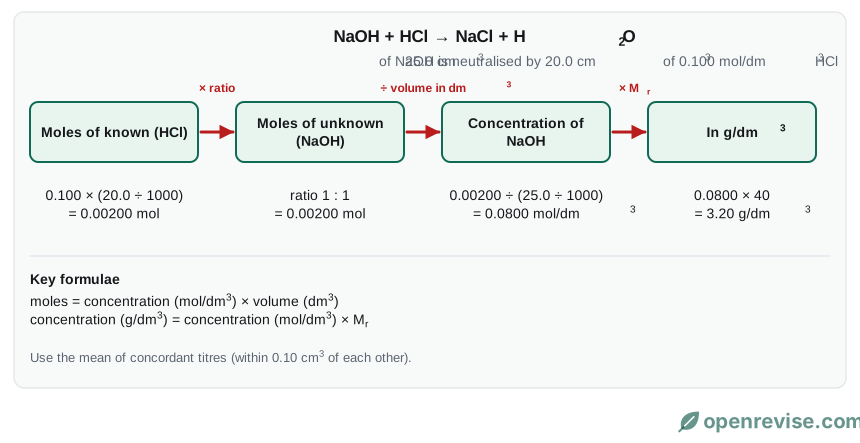
- Work out the moles of the solution whose concentration you know (concentration × volume in dm3).
- Use the balanced equation to find the moles of the other substance.
- Divide by its volume in dm3 to find its concentration.
When the ratio is not 1 : 1
Example: 25.0 cm3 of sodium hydroxide is neutralised by 12.5 cm3 of 0.100 mol/dm3 sulfuric acid.
H2SO4 + 2NaOH → Na2SO4 + 2H2O
- moles of H2SO4 = 0.100 × 0.0125 = 0.00125 mol
- ratio 1 : 2, so moles of NaOH = 2 × 0.00125 = 0.00250 mol
- concentration of NaOH = 0.00250 ÷ 0.0250 = 0.100 mol/dm3
Finding an unknown volume
Rearrange: volume (dm3) = moles ÷ concentration. Multiply by 1000 to get cm3.
Test yourself on this lesson
5 exam questions · 10 marks · with mark schemes and model answers
Found a mistake?