3.9 Percentage yield
What the yield of a reaction is, how to calculate percentage yield and theoretical yield, and why the actual yield is almost always less than the theoretical yield.
Separate only
AQA
Edexcel
OCR
1 min read
Yield
Key terms
- Yield: the amount of product obtained from a reaction.
- Theoretical yield: the maximum mass of product that could be made, calculated from the balanced equation.
- Percentage yield: the actual yield as a percentage of the theoretical yield.
percentage yield = actual yield / theoretical yield × 100
Example: a reaction should make 20.0 g of product, but only 14.0 g is collected.
percentage yield = 14.0 ÷ 20.0 × 100 = 70%
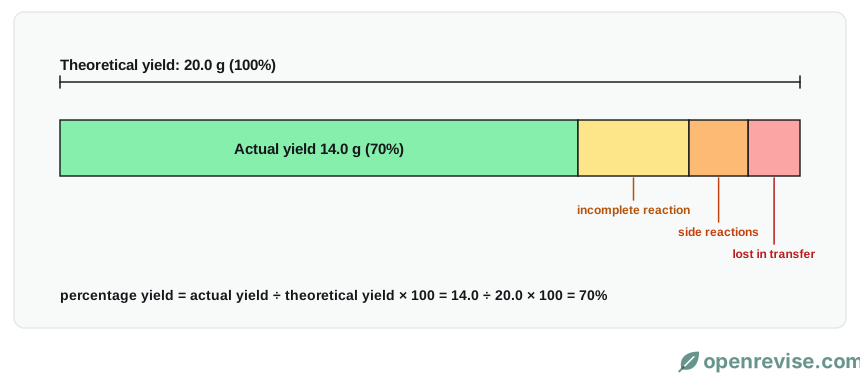
Why the yield is less than 100%
It is almost impossible to get a 100% yield, because:
- the reaction may not go to completion, for example because it is reversible
- some of the reactants may take part in side reactions (unexpected or competing reactions), making other products
- some product is lost when it is separated from the mixture, for example left on filter paper or in the apparatus when transferring
- the reactants may not be pure
Calculating the theoretical yield
Use a reacting mass calculation (this part is Higher tier for AQA).
Example: 50 g of calcium carbonate is heated. CaCO3 → CaO + CO2
- moles of CaCO3 = 50 ÷ 100 = 0.50 mol
- moles of CaO = 0.50 mol, so theoretical yield = 0.50 × 56 = 28 g
- if 22.4 g of CaO is collected: percentage yield = 22.4 ÷ 28 × 100 = 80%
Why it matters
A high percentage yield means less waste of reactants and energy, and lower costs. This is important for industry and for sustainable development.
Test yourself on this lesson
5 exam questions · 12 marks · with mark schemes and model answers
Found a mistake?