6.3 Catalysts
What catalysts are, how they increase the rate of reaction by providing a pathway with a lower activation energy, how to show this on a reaction profile, how to identify a catalyst, and enzymes as biological catalysts.
What a catalyst does
Key terms
- Catalyst: a substance that changes the rate of a chemical reaction but is not used up in the reaction.
- Enzyme: a biological catalyst, a protein made by living cells.
Catalysts increase the rate of reactions. They are not used up, so they are not included in the chemical equation (they may be written above the arrow), and the same mass is left at the end. Different reactions need different catalysts.
How catalysts work
A catalyst provides a different pathway for the reaction that has a lower activation energy. More of the collisions have at least this lower activation energy, so more collisions are successful and the rate increases.
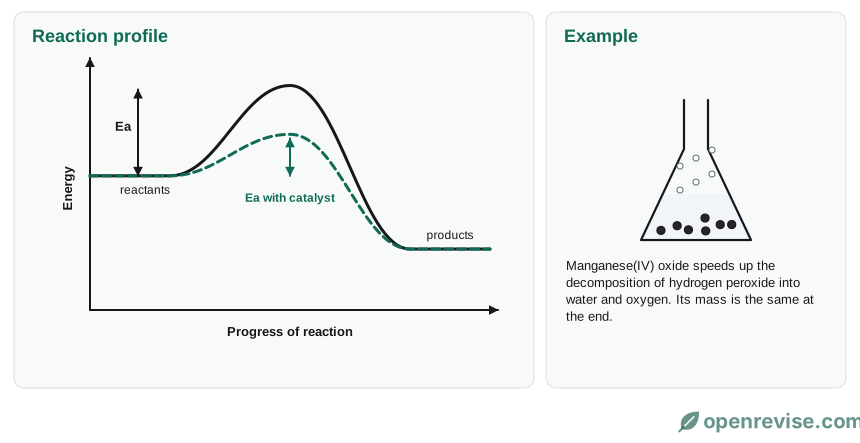
On a reaction profile, the catalysed reaction has a lower peak, but the reactants and products are at the same energy levels, so the overall energy change is the same.
Identifying a catalyst
To show a substance is a catalyst:
- the reaction is faster when it is added
- its mass is the same at the end (filter, dry and weigh it)
- it is chemically unchanged, so it can be reused.
Example: manganese(IV) oxide speeds up the decomposition of hydrogen peroxide: 2H2O2 → 2H2O + O2.
Catalysts in industry and in living things
- Iron is the catalyst in the Haber process for making ammonia.
- Catalysts let industrial reactions run fast at lower temperatures, which saves energy and money.
- Enzymes are biological catalysts. They are used in industry, for example yeast enzymes in making alcoholic drinks by fermentation.
Test yourself on this lesson
6 exam questions · 10 marks · with mark schemes and model answers
Found a mistake?