6.2 Collision theory and factors affecting rate
Collision theory: reactions happen when particles collide with at least the activation energy. How concentration, pressure, surface area and temperature change the frequency and energy of collisions, and so the rate.
Collision theory
Key terms
- Collision theory: chemical reactions can only happen when reacting particles collide with sufficient energy.
- Activation energy: the minimum amount of energy that particles must have to react.
- Surface area to volume ratio: how much surface a solid has compared with its size; smaller pieces have a higher ratio.
For a reaction to happen, particles must collide, and they must collide with at least the activation energy. Collisions with less energy just bounce off.
The rate of a reaction depends on:
- the frequency of collisions (how many happen each second)
- the energy of the collisions.
The four factors
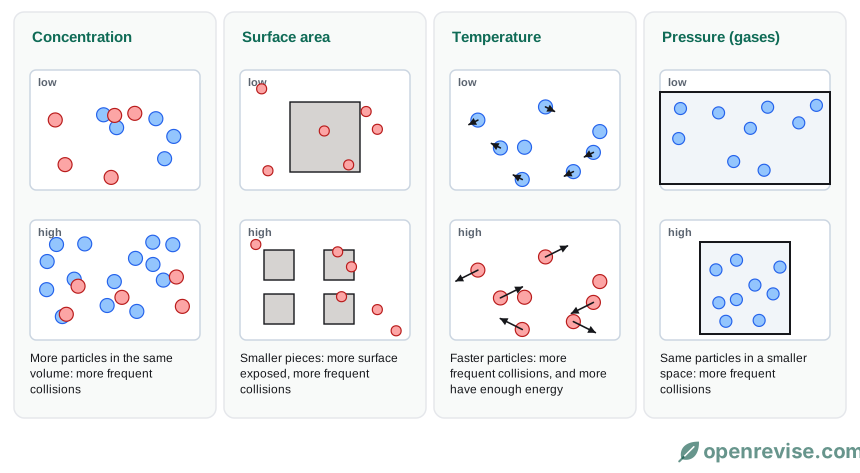
| Factor | Effect | Why |
|---|---|---|
| Concentration of a solution | Higher: faster | More particles in the same volume, so more frequent collisions |
| Pressure of a gas | Higher: faster | The same number of particles in a smaller space, so more frequent collisions |
| Surface area of a solid | Smaller pieces (powder): faster | Higher surface area to volume ratio, so more particles are exposed and collisions are more frequent |
| Temperature | Higher: faster | Particles move faster, so they collide more often, and more collisions have energy at least equal to the activation energy |
Temperature has the biggest effect, because it changes both the frequency and the energy of collisions. A rise of 10 °C roughly doubles the rate of many reactions.
Describing and explaining
When a question asks you to explain, use the words frequency of collisions and, for temperature, energy and activation energy. For example: "At a higher concentration there are more acid particles in the same volume, so there are more frequent collisions with the marble, so the rate increases."
Test yourself on this lesson
6 exam questions · 12 marks · with mark schemes and model answers
Found a mistake?