6.4 Required practical: rates of reaction
The required practical on how concentration affects the rate of reaction: the disappearing cross method with sodium thiosulfate and acid, the gas collection method with marble chips or magnesium, variables, calculating 1/time, and improving accuracy.
The aim
To investigate how changing the concentration affects the rate of reaction. This is AQA required practical 5, Edexcel core practical 7.1 and OCR PAG C8. AQA uses two methods: a colour change (turbidity) and volume of gas. Edexcel's core practical uses marble chips and hydrochloric acid (gas) and sodium thiosulfate (colour change).
Key terms
- Independent variable: the concentration of the reactant.
- Dependent variable: the time taken, or the volume of gas produced.
- Control variables: temperature, volumes, the mass and size of solid pieces.
Method 1: disappearing cross
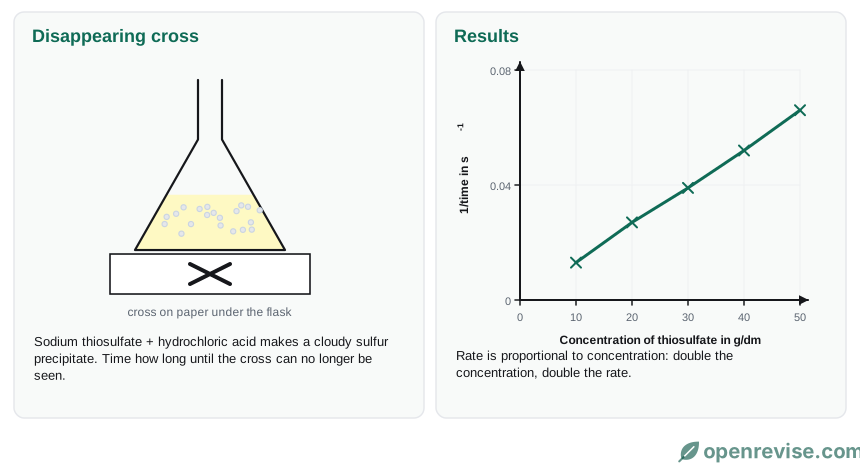
- Draw a black cross on a piece of paper and put a conical flask on it.
- Add 50 cm3 of sodium thiosulfate solution of a known concentration.
- Add 10 cm3 of dilute hydrochloric acid, swirl and start a stopwatch.
- A pale yellow sulfur precipitate forms, making the mixture cloudy. Stop the clock when you can no longer see the cross from above.
- Repeat with different concentrations of sodium thiosulfate (dilute it with water, keeping the total volume the same).
Method 2: volume of gas
- Put a measured volume of hydrochloric acid of known concentration in a conical flask.
- Add a set mass of magnesium ribbon (or marble chips of the same size), and quickly fit a bung connected to a gas syringe (or an upturned measuring cylinder in a trough of water).
- Record the volume of gas every 10 seconds.
- Repeat with different concentrations of acid. Plot volume against time for each; the steeper the initial slope, the faster the rate.
Making it reliable
- Keep the temperature the same: it has a big effect on rate.
- The same person should judge when the cross disappears, looking from the same height. A light sensor and data logger removes the judgement.
- Repeat each concentration at least three times and calculate a mean.
Safety
Wear eye protection. Sulfur dioxide gas is produced in the thiosulfate reaction, so keep the room well ventilated, and people with asthma should take care.
Test yourself on this lesson
6 exam questions · 16 marks · with mark schemes and model answers
Found a mistake?