6.5 Reversible reactions
What reversible reactions are and the ⇌ symbol, how changing conditions changes the direction of a reaction (ammonium chloride, hydrated copper sulfate), and why the energy transferred is the same in each direction but exothermic one way and endothermic the other.
Reactions that go both ways
Key terms
- Reversible reaction: a reaction in which the products can react to make the original reactants again.
- Forward reaction: the reaction from left to right in the equation.
- Reverse (backward) reaction: the reaction from right to left.
In some chemical reactions, the products can react to produce the original reactants. These are reversible reactions, shown with the symbol ⇌:
The direction of a reversible reaction can be changed by changing the conditions, such as temperature.
Examples
Ammonium chloride: when heated, solid ammonium chloride decomposes into two gases. At the cool top of the test tube, they recombine to form white solid again.
Hydrated copper sulfate:
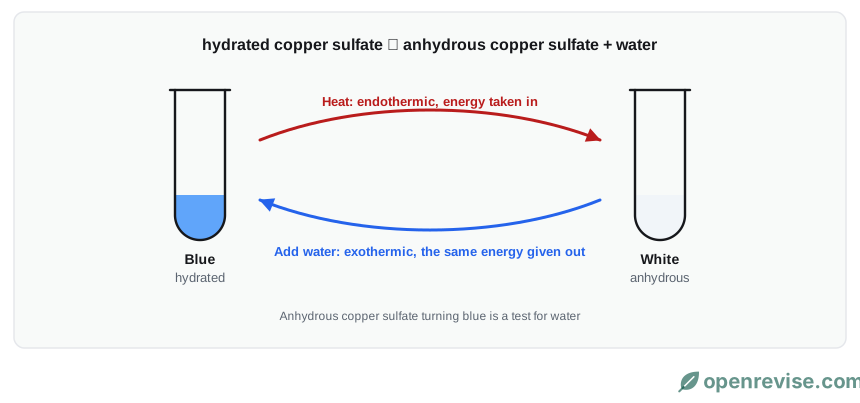
Heating removes the water, and the blue crystals turn white. Adding water turns the white powder blue again. This colour change is used as a test for water.
Energy changes
If a reversible reaction is exothermic in one direction, it is endothermic in the opposite direction. The same amount of energy is transferred in each case.
- Heating hydrated copper sulfate is endothermic: energy is taken in.
- Adding water to anhydrous copper sulfate is exothermic: the same amount of energy is given out, and the mixture gets hot.
Test yourself on this lesson
5 exam questions · 8 marks · with mark schemes and model answers
Found a mistake?