6.6 Dynamic equilibrium
What dynamic equilibrium is: in a closed system, the forward and reverse reactions keep happening at the same rate, so the amounts of reactants and products stay constant, though not equal.
Equilibrium
Key terms
- Closed system: one where no substances can get in or out.
- Dynamic equilibrium: the state of a reversible reaction in a closed system when the forward and reverse reactions happen at exactly the same rate.
When a reversible reaction happens in a closed system (for example, a sealed container), it eventually reaches equilibrium.
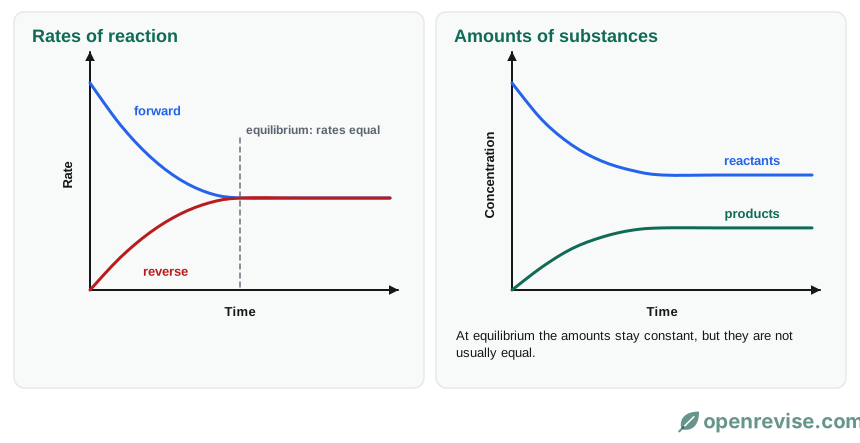
How equilibrium is reached
- At the start there are only reactants, so the forward reaction is fast and the reverse reaction does not happen.
- As the reactants are used up, the forward reaction slows down.
- As products build up, the reverse reaction speeds up.
- Eventually the forward and reverse reactions happen at exactly the same rate.
Why "dynamic"?
At equilibrium, both reactions are still happening: particles keep reacting in both directions. But because the rates are equal, the amounts (concentrations) of the reactants and products stay constant.
It does not mean the amounts of reactants and products are equal. The position of equilibrium can lie towards the reactants (more reactants than products) or towards the products.
Why a closed system?
If a product can escape, for example a gas from an open flask, the reverse reaction cannot happen properly, so equilibrium is never reached.
Test yourself on this lesson
5 exam questions · 9 marks · with mark schemes and model answers
Found a mistake?