Viewing as
Teacher view: planning notes, the answers to every question, and the teacher copies of the files.
History · Crime and punishment in medieval England
The Role of the Church in Crime and Punishment
Church courts, sanctuary, benefit of clergy and the end of trial by ordeal - how the Church shaped medieval justice, and why kings were not always happy about it.
Teacher resources
The teacher copies: slides with the questions built in, the answers, and anything else attached to this lesson for whoever is teaching it.
- The Role of the Church in Crime and Punishment - Teacher Slides.pptx Teacher The lesson slides with the teacher's notes on each slide, and every question and mark scheme built in. Built from the lesson script on 23 September 2026. View
- The Role of the Church in Crime and Punishment - Teacher Notes.docx Teacher The complete notes with the teacher's notes and every model answer in full. Built from the lesson script on 23 September 2026. View
Student handouts
The same files the students see, to print or hand out.
- The Role of the Church in Crime and Punishment.pptx Built from the lesson script on 23 September 2026. View
- The Role of the Church in Crime and Punishment - Completed Notes.docx The full notes for the lesson, every gap filled in - to check against, or to revise from. Built from the lesson script on 23 September 2026. View
- The Role of the Church in Crime and Punishment - Exam Questions.docx Built from the lesson script on 23 September 2026. View
Learning Objectives
- 1Describe the work of Church courts and the punishments they gave.
- 2Explain how sanctuary and benefit of clergy worked, and why they caused conflict.
- 3Explain why trial by ordeal ended in 1215, and assess the significance of the Church's influence.
Setting the Scene
In medieval England the Church was as powerful as the king. Almost everyone believed in Heaven and Hell, and the Church owned land, collected taxes and ran its own courts. The Church saw crime as sin, and it believed sinners should have the chance to repent - which meant its justice was often gentler than the king's.
- 1070s William I sets up separate Church courts.
- 1164 Henry II's Constitutions of Clarendon try to limit Church courts.
- 1170 Archbishop Thomas Becket is murdered in Canterbury Cathedral.
- 1215 The Pope bans priests from taking part in trials by ordeal.
Church Courts
The Church dealt with its own - and with sins as well as crimes.
-
Who they tried
Members of the clergy - priests, monks and nuns - for any crime, and anyone for moral crimes such as adultery, drunkenness or failing to go to church.
-
Punishments
Church courts never sentenced anyone to death. They used penance, fines, public shaming and, at worst, excommunication.
-
Why gentler
The Church believed punishment should give sinners the chance to repent and save their souls.
-
Criticism
Many people thought Church courts let criminal clergy off too lightly.
Sanctuary and Benefit of Clergy
Two ways the Church protected people from the king's courts.
-
Sanctuary
A person accused of a crime could claim protection in a church. After 40 days they had to face trial or leave England.
-
Abjuring the realm
Leaving England: the fugitive walked to a named port, barefoot and carrying a cross, and took the first ship.
-
Benefit of clergy
Clergy accused of a crime could be tried in a Church court, where there was no death penalty.
-
The neck verse
To prove they were clergy, the accused read a passage from the Bible - later Psalm 51. People learned it by heart to escape hanging.
Church Against Crown: Thomas Becket
Henry II wanted clergy who committed serious crimes to be punished in the king's courts. His Archbishop of Canterbury, Thomas Becket, refused. In 1170 four of Henry's knights murdered Becket in his own cathedral.
Why it mattered
- Martyr Becket was made a saint and Canterbury became a place of pilgrimage.
- Henry backs down Henry did public penance, and benefit of clergy survived for the rest of the Middle Ages.
- Church and crown The case shows the Church's power over justice - even against a strong king.
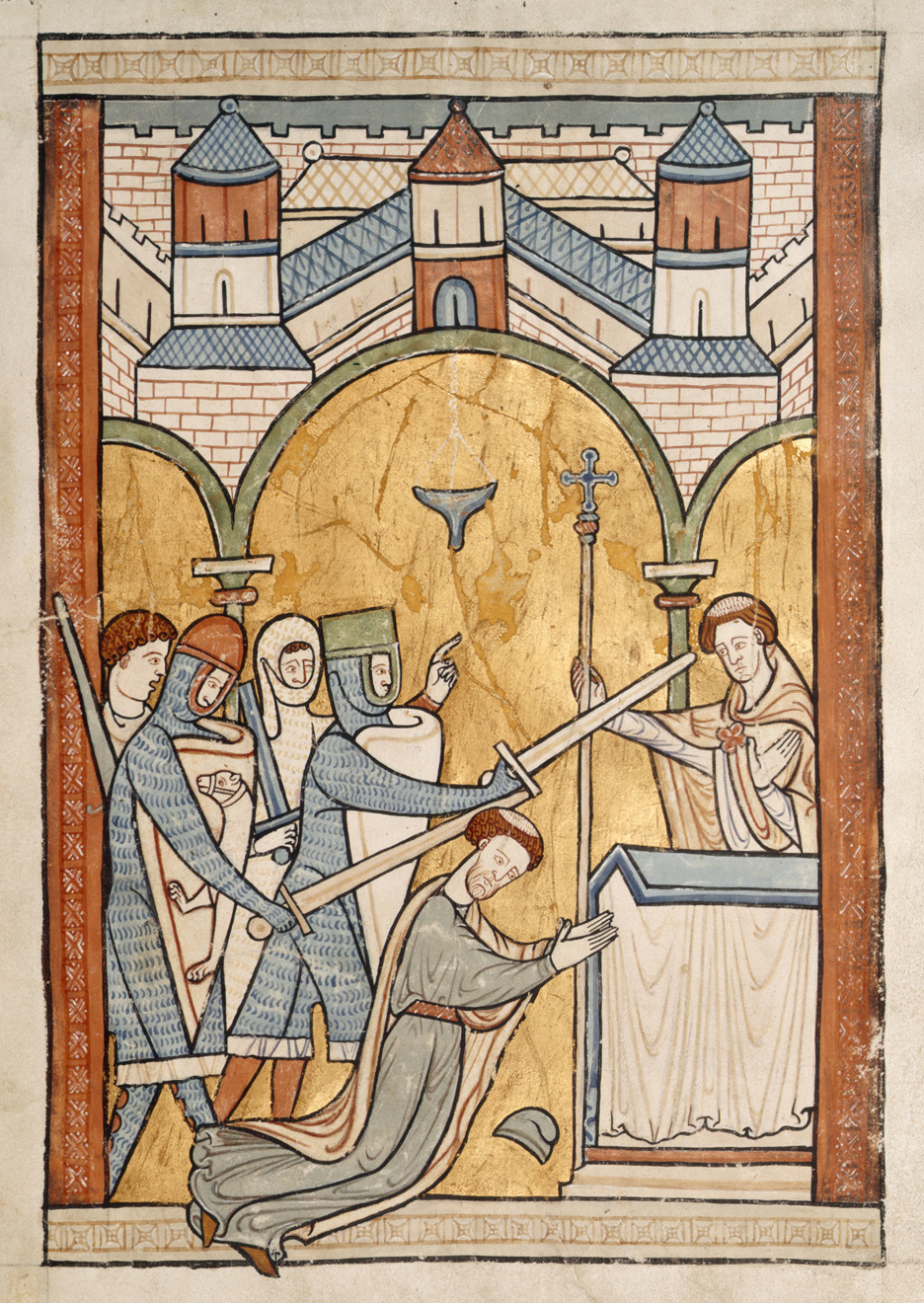
The murder of Thomas Becket, 1170.
The End of Trial by Ordeal
The Church had run the ordeals - and in 1215 it stopped.
-
The decision
In 1215 Pope Innocent III's Fourth Lateran Council banned priests from taking part in trials by ordeal.
-
Why
Many churchmen doubted that God should be asked to perform a miracle to decide a court case, and ordeals were open to trickery.
-
The effect
Without priests, ordeals could not work. By the 1220s trial by jury replaced them in the king's courts.
-
Significance
A decision made by the Church changed how guilt was decided in England.
Did the Church Help or Hinder Justice?
It helped
- Gave accused people protection from hasty punishment through sanctuary.
- Offered a chance to repent instead of death.
- Its decision in 1215 led to trial by jury - a fairer system.
It hindered
- Benefit of clergy let criminal clergy escape hanging.
- Sanctuary could let the guilty escape justice.
- It clashed with the king over who had authority.
Summary & Exam Focus
- Church courts tried clergy and moral crimes, and never used the death penalty.
- Sanctuary gave fugitives 40 days' protection before trial or leaving England.
- Benefit of clergy let the clergy - and later anyone who could read - escape hanging.
- In 1215 the Church ended trial by ordeal, leading to trial by jury.
Exam focus
Explain why the Church had an important influence on crime and punishment in the early thirteenth century. (12 marks) (12 marks)
Explain each factor - sanctuary, benefit of clergy, the end of the ordeal - and say why it mattered, not just what it was.
Key terms
The vocabulary this lesson expects you to use. Each one is linked from the first place it appears above.
- Church courts
- Courts run by the Church for clergy and moral crimes; never gave the death penalty.
- Sanctuary
- Protection given to an accused person who took refuge in a church.
- Abjuring the realm
- Leaving England for ever instead of facing trial.
- Benefit of clergy
- The right of clergy to be tried in Church courts.
- Neck verse
- Psalm 51, read to prove you were clergy and escape hanging.
- Excommunication
- Being cut off from the Church - believed to mean going to Hell.
- Fourth Lateran Council
- The Church meeting of 1215 that ended priests' part in trial by ordeal.
Questions and answers
9 questions set on this lesson, with the mark schemes and model answers open.
Explain one way in which the way guilt was decided in the period c1000-c1200 was different from the way guilt was decided in the period c1200-c1500.
Mark scheme — 4 marks available
- A valid difference identified — 1-2 marks
- Supported with specific knowledge of both periods — 3-4 marks
Model answer
Before 1200, if oath-helpers could not settle a case, guilt was decided by trial by ordeal, where people believed God would reveal the truth - for example through trial by hot iron or cold water. After the Church banned priests from taking part in ordeals in 1215, guilt was decided by trial by jury, where local men judged the evidence. So guilt moved from being decided by God to being decided by people.
Explain why the Church had an important influence on crime and punishment in the early thirteenth century. You may use the following in your answer: sanctuary; trial by ordeal. You must also use information of your own.
Mark scheme — 12 marks available
- Level 1 (1-3) — A simple or general answer
- Level 2 (4-6) — Some explanation of one or more reasons, with some knowledge
- Level 3 (7-9) — A developed explanation linked to the question, with accurate knowledge
- Level 4 (10-12) — An analytical explanation of several reasons, with knowledge that goes beyond the stimulus points
Model answer
One reason was that the Church could protect accused people from the king's justice through sanctuary. A person who reached a church could claim protection for 40 days, after which they either faced trial or abjured the realm, walking to a port and leaving England. This meant the Church, not the king, decided what happened to some fugitives. A second reason was the Church's decision in 1215 to end trial by ordeal. The ordeals relied on priests to bless the water or iron, so when Pope Innocent III's Fourth Lateran Council banned priests from taking part, they could no longer be held. This forced the king's courts to find a new way of deciding guilt, and by the 1220s trial by jury had replaced the ordeal - a lasting change caused directly by the Church. A third reason, beyond the stimulus, was benefit of clergy. Clergy accused of crimes could be tried in Church courts, which never used the death penalty, and Henry II's failure to change this after the murder of Thomas Becket in 1170 showed how strong the Church's position was. The Church therefore shaped who was tried, how they were tried, and how they were punished.
"The Church was the most important influence on crime and punishment in the period c1000-c1500." How far do you agree? Explain your answer. You may use the following in your answer: benefit of clergy; the Statute of Labourers (1351). You must also use information of your own. (16 marks, plus 4 for spelling, punctuation, grammar and specialist terminology)
Mark scheme — 16 marks available
- Level 1 (1-4) — A simple or generalised answer
- Level 2 (5-8) — Some analysis, with a judgement that is asserted
- Level 3 (9-12) — Analysis of both sides with accurate knowledge and a supported judgement
- Level 4 (13-16) — Sustained analysis, knowledge beyond the stimulus, and a clear, justified judgement
- SPaG (4) — Accurate spelling, punctuation and grammar, with specialist terms such as sanctuary and benefit of clergy
Model answer
On the one hand, the Church had a major influence throughout the period. It ran trial by ordeal until 1215, and its decision to end it led to trial by jury. Church courts tried clergy and moral crimes and never gave the death penalty, and benefit of clergy let criminal clergy - and later anyone who could read the neck verse - escape hanging. Sanctuary gave fugitives protection. When Henry II tried to limit this, the murder of Becket in 1170 forced him to back down. On the other hand, kings and governments were arguably more important. The Normans' Forest Laws and murdrum fine were created by the king to protect royal power. Royal justice grew steadily - Henry II's Assize of Clarendon (1166), travelling judges, coroners and Justices of the Peace. New crimes were created by the government in response to events, such as the Statute of Labourers of 1351 after the Black Death, and the Treason Act of 1351. Even heresy laws in 1401 were enforced by the state burning heretics. Overall, the Church's influence was very significant in how guilt was decided and in protecting some people from punishment, but the king and government were the main influence on what counted as a crime and how most people were punished. Over the period royal power grew while the Church's role became more limited.
How long could someone stay in sanctuary before facing trial or leaving England?
Why: Forty days - after that they had to face trial or abjure the realm.
What was the "neck verse"?
Why: Psalm 51, read aloud to prove you were clergy and claim benefit of clergy - saving your neck from hanging.
Which punishment did Church courts never use?
Why: Church courts believed sinners should have the chance to repent, so they never sentenced anyone to death.
What happened in 1215 that ended trial by ordeal?
Why: The Fourth Lateran Council banned priests from taking part, so ordeals could no longer be held.
Who was murdered in 1170 after a dispute with Henry II over Church courts?
Why: Archbishop Thomas Becket was killed in Canterbury Cathedral by four of Henry's knights.
What replaced trial by ordeal in the king's courts by the 1220s?
Why: Trial by jury - local men judged the evidence instead of asking God to decide.