Maths · Further Algebra
Viewing as
Teaching this? The teacher view opens every answer and mark scheme.
Simultaneous Equations
Solving pairs of equations by elimination, substitution and graphs, including a linear and a quadratic equation.
Learning Objectives
- 1Solve a pair of linear simultaneous equations by elimination and by substitution.
- 2Solve simultaneous equations graphically, by reading the point where two lines cross.
- 3Form simultaneous equations from a problem and solve them.
- 4Solve a pair where one equation is quadratic or a circle (Higher tier).
Two equations, one answer
Simultaneous equations are two equations that must both be true at the same time. With two unknowns, such as \(x\) and \(y\), one equation is not enough, but two give a single pair of values. They appear on almost every Paper 1, and a typical question gives you the numbers so that nothing is awkward to work out. The marks are for a clear method, and the final check, putting your answers in the other equation, protects you from silly errors.
Where two lines meet
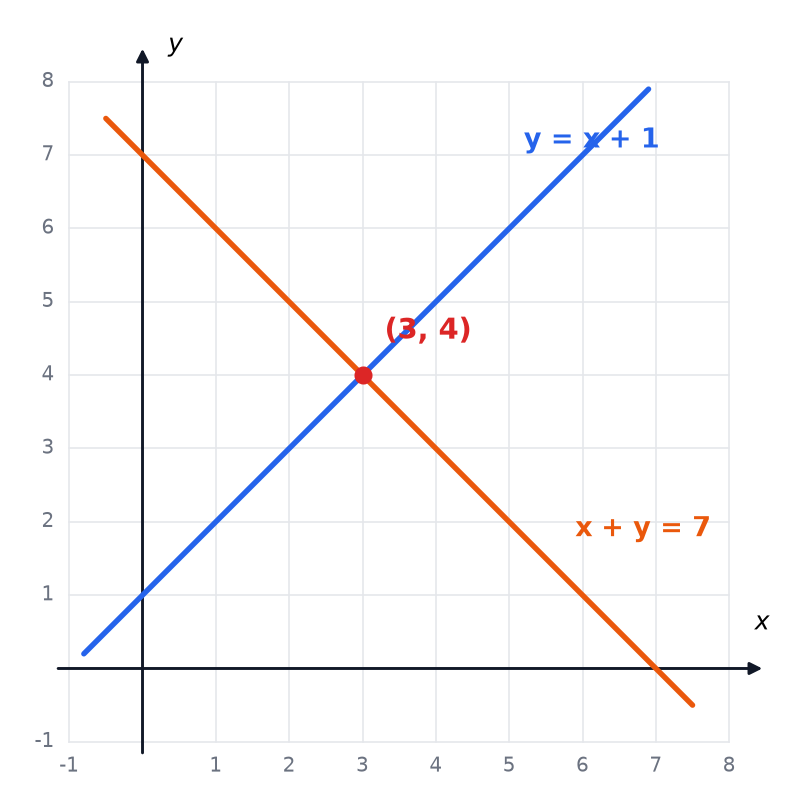
Each line is all the points that fit one equation. The point where they cross fits both, so it is the solution of the pair of simultaneous equations: \(x = 3\) and \(y = 4\).
Solving by graph
- Draw both lines Use a table of values or the gradient and intercept for each.
- Read the crossing point The coordinates \((x, y)\) of the crossing are the solution.
- Check Put \(x = 3\) and \(y = 4\) into both equations: \(4 = 3 + 1\) and \(3 + 4 = 7\).
- Parallel lines If the lines never meet, there is no solution.
Elimination
Add or subtract the equations to get rid of one letter. It is the quickest method when the equations are in the same form.
-
Make a pair of terms match
If the \(y\)-terms are equal, subtract the equations. If they are opposites, add them.
-
Multiply if you need to
Multiply one or both equations so the numbers in front of one letter match.
-
Solve for one letter, then the other
Substitute your first answer back into one of the original equations.
-
Always check
Put both answers in the equation you did not use.
Elimination by subtracting
Solve \(3x + 2y = 16\) and \(x + 2y = 8\).
Show the solutionHide the solution
- 1 Match the y terms Both equations have \(2y\), so subtract the second from the first.
- 2 Subtract \((3x - x) + (2y - 2y) = 16 - 8\), so \(2x = 8\) and \(x = 4\).
- 3 Find y Put \(x = 4\) into \(x + 2y = 8\): \(4 + 2y = 8\), so \(y = 2\).
- 4 Check \(3 \times 4 + 2 \times 2 = 16\). Correct.
Answer\(x = 4\), \(y = 2\)
Elimination after multiplying
Solve \(2x + 3y = 13\) and \(3x - y = 3\).
Show the solutionHide the solution
- 1 Match the y terms Multiply the second equation by 3: \(9x - 3y = 9\).
- 2 Add \(2x + 3y + 9x - 3y = 13 + 9\), so \(11x = 22\) and \(x = 2\).
- 3 Find y \(3 \times 2 - y = 3\), so \(y = 3\).
- 4 Check \(2 \times 2 + 3 \times 3 = 13\). Correct.
Answer\(x = 2\), \(y = 3\)
Substitution
When one equation already gives a letter on its own, replace it in the other equation.
-
Spot the easy equation
\(y = 2x + 1\) has \(y\) on its own.
-
Replace
In \(3x + y = 16\), write \(3x + (2x + 1) = 16\).
-
Solve
\(5x + 1 = 16\), so \(x = 3\). Then \(y = 2 \times 3 + 1 = 7\).
-
Use brackets
When you substitute an expression, put it in brackets to avoid sign mistakes.
Problems with simultaneous equations
In a word problem, define the letters, write one equation for each statement, and solve.
-
Define the letters
"Let \(a\) be the cost of an adult ticket and \(c\) the cost of a child ticket."
-
Write two equations
"2 adult and 3 child tickets cost £19" gives \(2a + 3c = 19\), and "3 adult and 1 child ticket cost £18" gives \(3a + c = 18\).
-
Solve them
From the second, \(c = 18 - 3a\). Then \(2a + 3(18 - 3a) = 19\), so \(2a + 54 - 9a = 19\), giving \(-7a = -35\) and \(a = 5\), \(c = 3\).
-
Answer in words
An adult ticket costs £5 and a child ticket £3.
A linear and a quadratic equation (Higher tier)
Substitute the linear equation into the quadratic one. You will get a quadratic, and so two pairs of solutions.
-
Example
Solve \(y = x^2\) and \(y = x + 6\). Set them equal: \(x^2 = x + 6\), so \(x^2 - x - 6 = 0\) and \((x - 3)(x + 2) = 0\).
-
Find both y-values
\(x = 3\) gives \(y = 9\), and \(x = -2\) gives \(y = 4\). The solutions are \((3, 9)\) and \((-2, 4)\).
-
A circle
For \(x^2 + y^2 = 25\) and \(y = x + 1\): \(x^2 + (x + 1)^2 = 25\) gives \(2x^2 + 2x - 24 = 0\), so \(x^2 + x - 12 = 0\) and \(x = 3\) or \(x = -4\), giving \((3, 4)\) and \((-4, -3)\).
-
Pair the answers
Each \(x\) goes with its own \(y\), so use the linear equation to find them.
Test yourself
-
1
When do you add the equations in elimination?
Show answerHide answer
When the terms in one letter are opposites, such as \(+3y\) and \(-3y\).
-
2
What does the crossing point of two lines mean?
Show answerHide answer
The solution of the pair of equations.
-
3
What is the first step in solving \(y = 2x + 1\) and \(3x + y = 16\)?
Show answerHide answer
Substitute \(2x + 1\) for \(y\) in the second equation.
-
4
How do you check the solution?
Show answerHide answer
Put both values into the equation you did not use.
-
5
How many solution pairs can a line and a parabola have (Higher tier)?
Show answerHide answer
Up to two.
Exam technique: simultaneous equations
The method is worth most of the marks, so show it clearly.
-
Label the equations
Call them (1) and (2) so you can say what you are adding or subtracting.
-
Subtract with care
Watch the signs, especially when subtracting a negative term.
-
Find both letters
Stopping after finding \(x\) loses the marks for \(y\).
-
Check your answer
Use the equation you did not substitute into.
Summary and exam focus
- Simultaneous equations are solved by elimination, substitution or by drawing both lines.
- Make the number in front of one letter match, then add or subtract to eliminate it.
- Find both \(x\) and \(y\), and check in the other equation.
- With a quadratic or a circle (Higher tier), substitute and solve a quadratic, giving two solution pairs.
Exam focus
Solve the simultaneous equations \(x + y = 9\) and \(x - y = 1\). (3 marks) (3 marks)
Adding the two equations eliminates \(y\), giving \(2x = 10\) and \(x = 5\). Then \(y = 4\). Check with \(5 - 4 = 1\). Writing the check in your answer shows you have verified it.
Key terms
The words this lesson expects you to use. Each one is linked from the first place it appears above.
- Simultaneous equations
- Equations that are true for the same values of the unknowns.
- Elimination
- Adding or subtracting equations to remove one unknown.
- Substitution
- Replacing a letter in one equation with its value or expression from another.
- Unknown
- A letter standing for a number that has to be found.
- Solution pair
- The values of \(x\) and \(y\) that make both equations true.
- Intersection
- The point where two lines or curves cross.
- Linear equation
- An equation whose graph is a straight line.
- Coefficient
- The number in front of a letter.
- Equation (1) and (2)
- Labels used to refer to each equation when you add or subtract them.
You've finished the notes
Check your understanding
Test yourself while it is fresh. Start with the flashcards, then try the exam questions.
Something here looks wrong?
Tell us what and we will go and look. It goes to whoever writes these pages, nobody else, and we do not ask who you are — so there is nothing to sign and nothing comes back to you.