Biology · Mitosis, Growth and Stem Cells
Viewing as
Teacher view: every answer and mark scheme set out in full.
The Cell Cycle and Mitosis
New cells are made when existing cells divide. This lesson follows a cell through the cell cycle, shows what happens to the chromosomes in mitosis, and explains why the two new cells are identical to the one they came from.
Learning Objectives
- 1Describe the three stages of the cell cycle, including mitosis.
- 2Explain what happens to the DNA and to the sub-cellular structures before a cell divides.
- 3Explain why mitosis produces two genetically identical cells.
- 4Explain why mitosis is important in growth, repair, replacement and asexual reproduction.
- 5Calculate how many cells there are after a number of divisions.
Retrieval practice
-
1
Where are the chromosomes in a human body cell?
Show answerHide answer
In the nucleus.
-
2
How many chromosomes are there in a human body cell?
Show answerHide answer
46, which is 23 pairs.
-
3
What is a gene?
Show answerHide answer
A short section of DNA that contains the instructions for making one protein.
-
4
Which sub-cellular structure releases energy by aerobic respiration?
Show answerHide answer
The mitochondrion.
New cells come from old cells
A new cell is never built from nothing. It is made when an existing cell divides in two. This is how a single fertilised egg becomes a baby, how a cut heals, and how your body replaces the cells that wear out every day. A cell does not simply split down the middle, because each new cell needs a full set of instructions and its own organelles. The series of stages a cell goes through to prepare for and carry out division is called the cell cycle.
The three stages of the cell cycle
The cell cycle is a loop. When it ends, each of the two new cells starts it again.
-
Stage 1: growth and DNA replication
The cell grows, and the number of sub-cellular structures such as ribosomes and mitochondria increases. The DNA replicates, so there are two copies of each chromosome. This is usually the longest stage.
-
Stage 2: mitosis
One set of chromosomes is pulled to each end of the cell, and the nucleus divides.
-
Stage 3: the cytoplasm divides
The cytoplasm and the cell membrane divide, forming two identical cells. These are called daughter cells.
The cell cycle
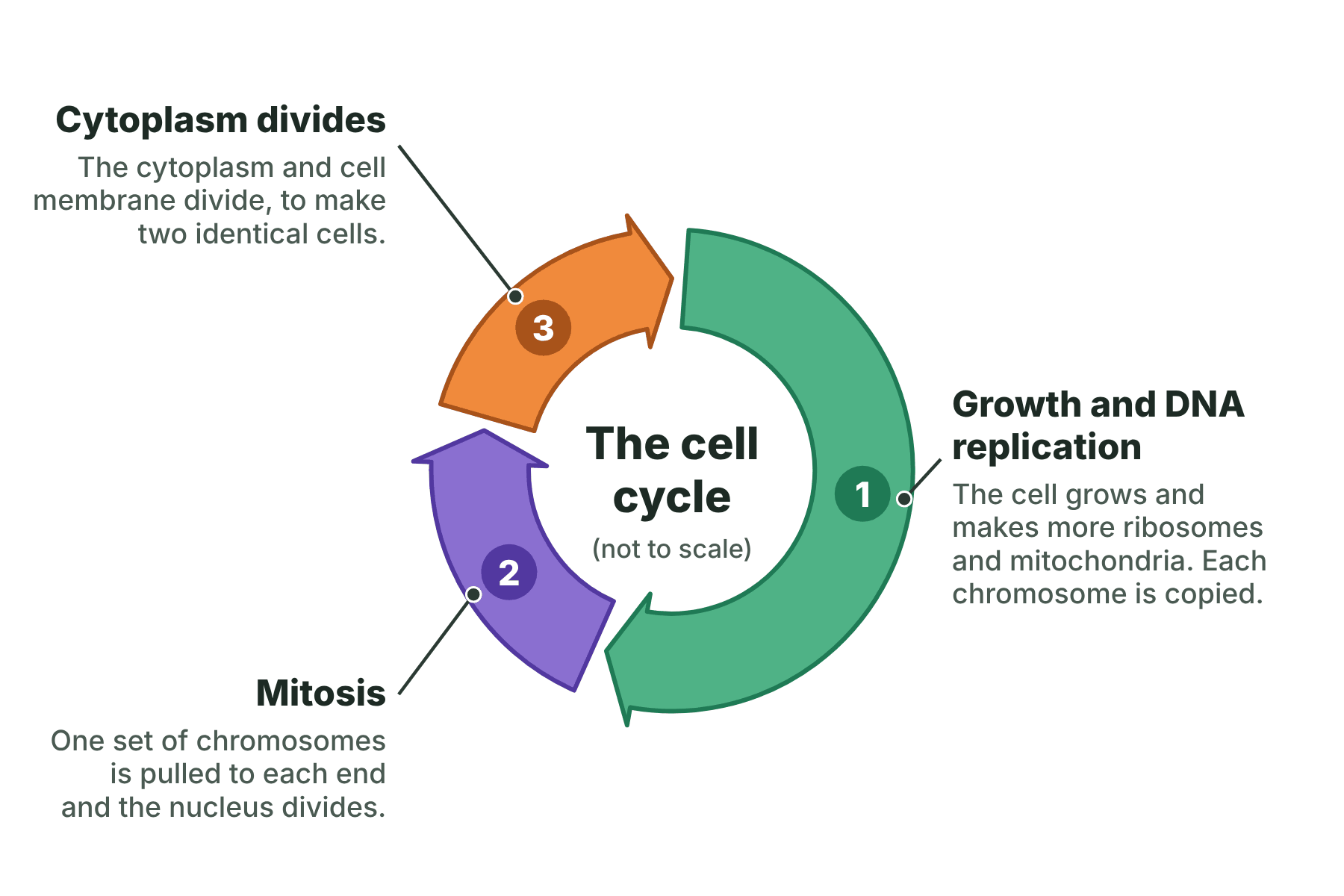
The three stages of the cell cycle. The stages are not drawn to scale: stage 1 takes by far the longest.
Mitosis, step by step
Follow one cell that has two pairs of chromosomes. A human cell would have 23 pairs, but the steps are the same.
-
1
The cell grows
Before dividing, the cell grows and makes more organelles, such as ribosomes and mitochondria, so each new cell will have enough.
-
2
The DNA is copied
Each chromosome is replicated, so there are now two identical copies of every chromosome, joined together.
-
3
The chromosomes line up
The chromosomes line up across the middle of the cell.
-
4
The copies are pulled apart
One set of chromosomes is pulled to each end of the cell.
-
5
New nuclei form
A nucleus forms around each set of chromosomes, and the cell starts to pinch in the middle.
-
6
The cytoplasm divides
The cytoplasm and cell membrane divide, making two identical daughter cells.
Mitosis in six steps
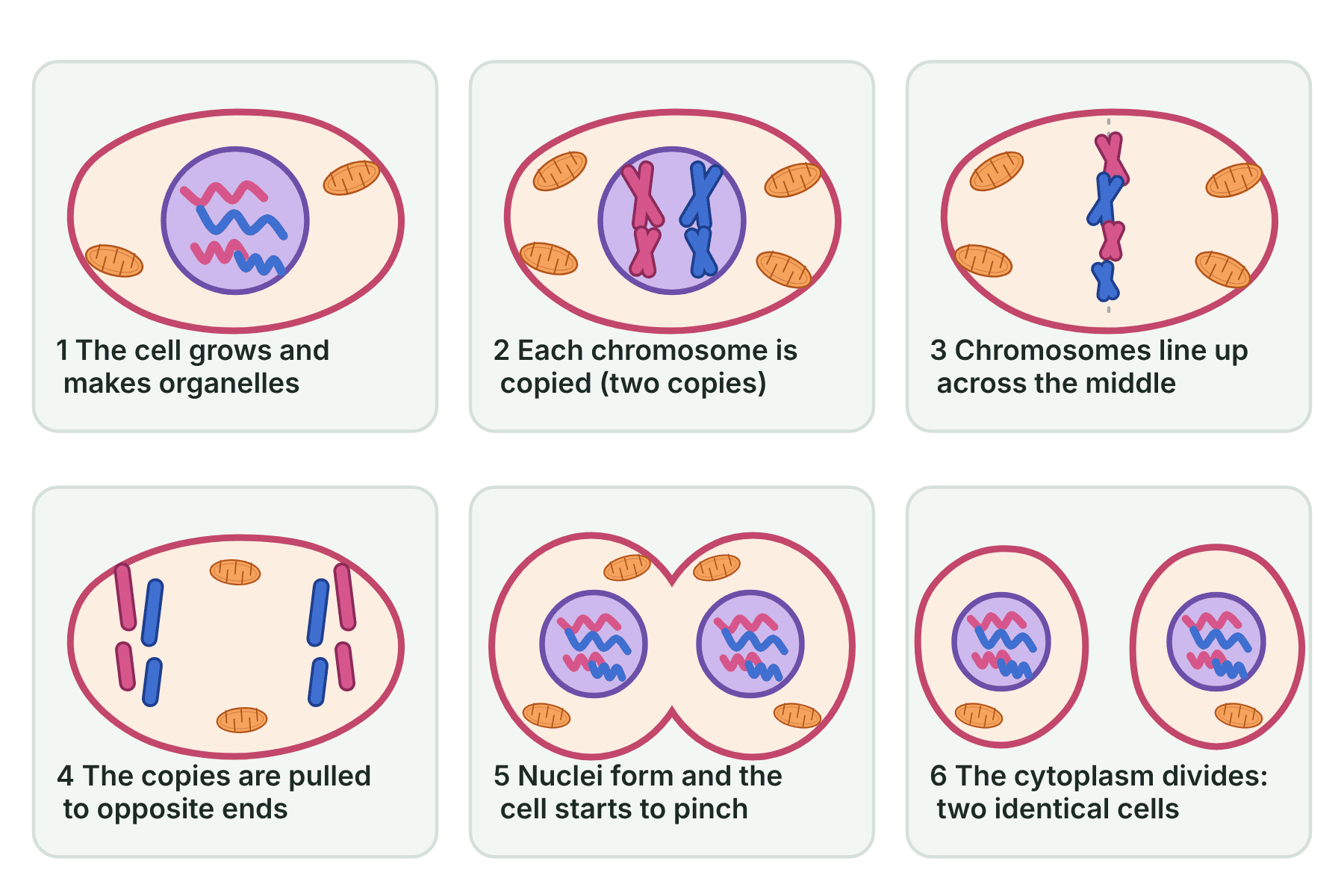
You do not need the names of the phases inside mitosis, but you do need these steps in order.
Why the two new cells are identical
Mitosis copies a cell, it does not mix cells up.
-
The DNA is copied exactly
Before mitosis the DNA replicates, so every chromosome has an identical copy.
-
Each cell gets one of each
One copy of every chromosome is pulled to each end, so each new nucleus has a complete set.
-
Same chromosomes, same genes
The daughter cells have the same number of chromosomes as the parent cell. A human cell with 46 chromosomes makes two cells with 46 chromosomes each.
-
Genetically identical
Because the genes are the same, the new cells are genetically identical to the parent cell and to each other.
Chromosome numbers stay the same
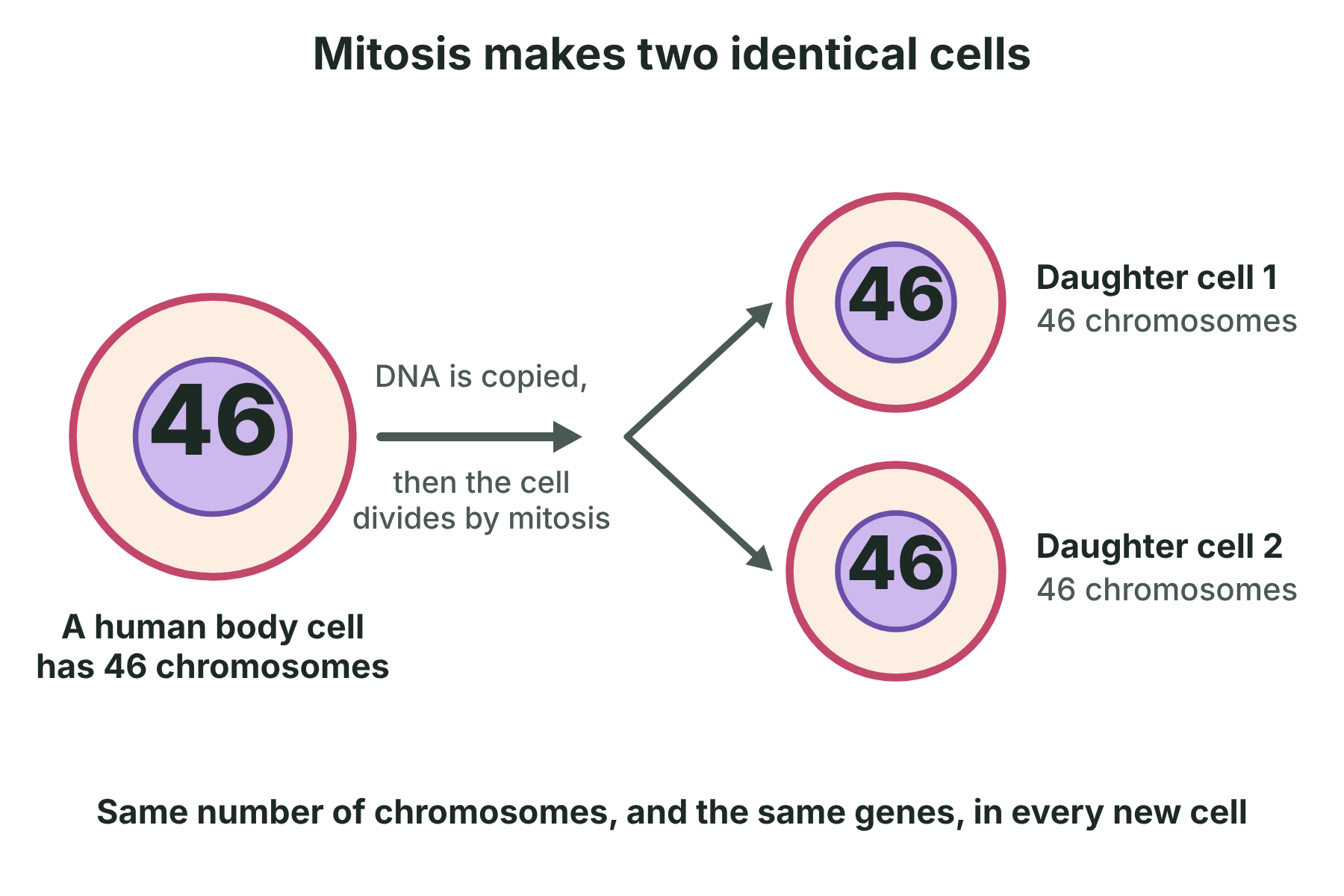
Mitosis makes two cells with the same chromosomes as the parent cell.
Why mitosis matters
Cell division by mitosis is important in the growth and development of multicellular organisms, and in more than that.
-
Growth and development
A fertilised egg becomes an adult because its cells divide again and again. More cells make a bigger organism.
-
Repair
When tissue is damaged, such as a cut in the skin, cells next to the damage divide by mitosis to make new cells that fill the gap.
-
Replacement
Many cells wear out and have to be replaced all the time, for example skin cells and the cells lining the gut.
-
Asexual reproduction
Some organisms make new individuals by mitosis alone. The offspring are genetically identical to the parent, so they are clones.
Three jobs for mitosis
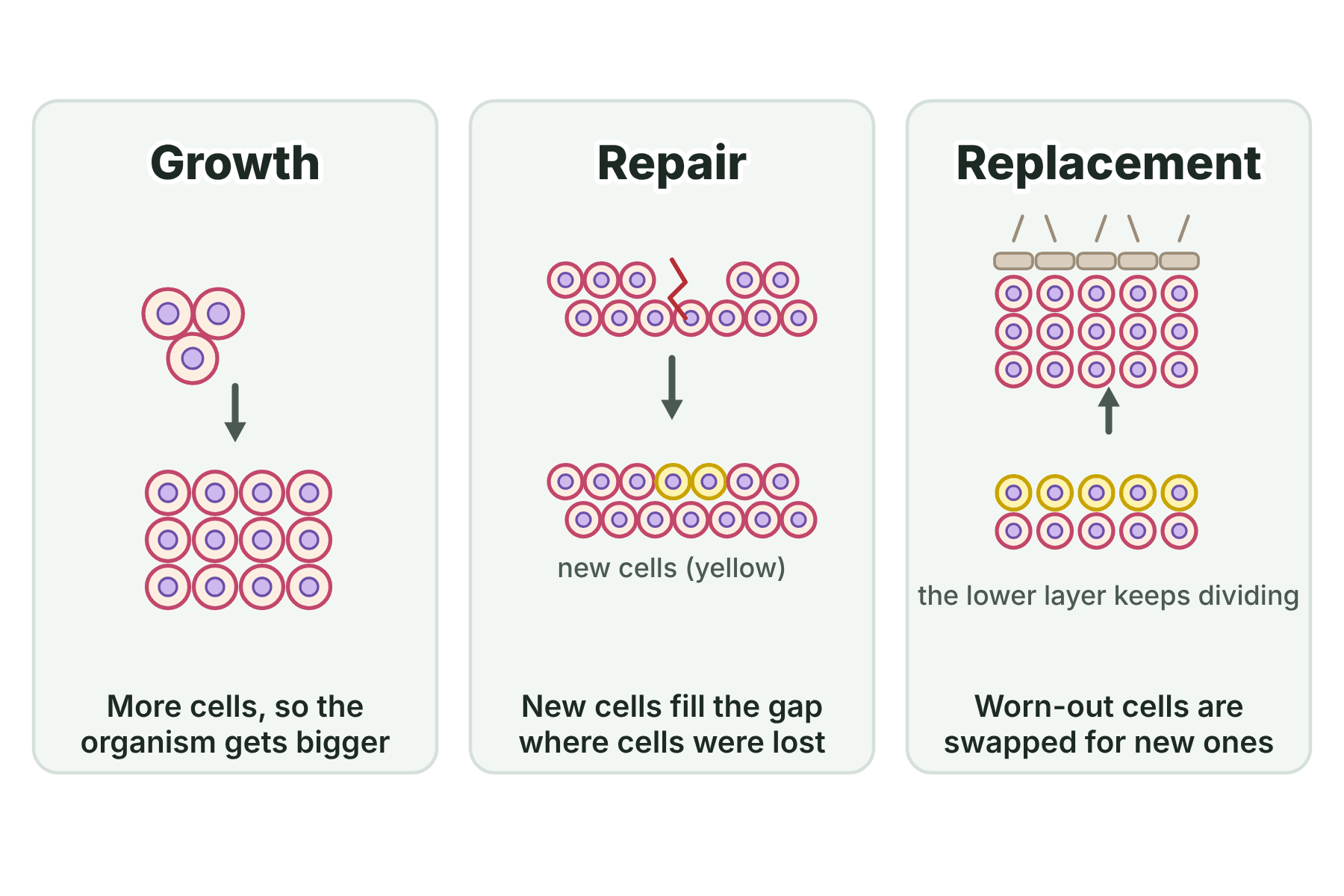
Growth, repair and replacement all depend on mitosis.
How many cells after a number of divisions?
A cell divides by mitosis. Both new cells then divide, and so do all the cells made after that. How many cells are there after 4 divisions?
Show the solutionHide the solution
- 1 Start with one cell After 0 divisions there is 1 cell.
- 2 Each division doubles the number 1 → 2 → 4 → 8 → 16, so after 4 divisions there are 16 cells.
- 3 Or use a power of 2 After n divisions there are \(2^{n}\) cells, and \(2^{4} = 2 \times 2 \times 2 \times 2 = 16\).
Answer16 cells.
Doubling
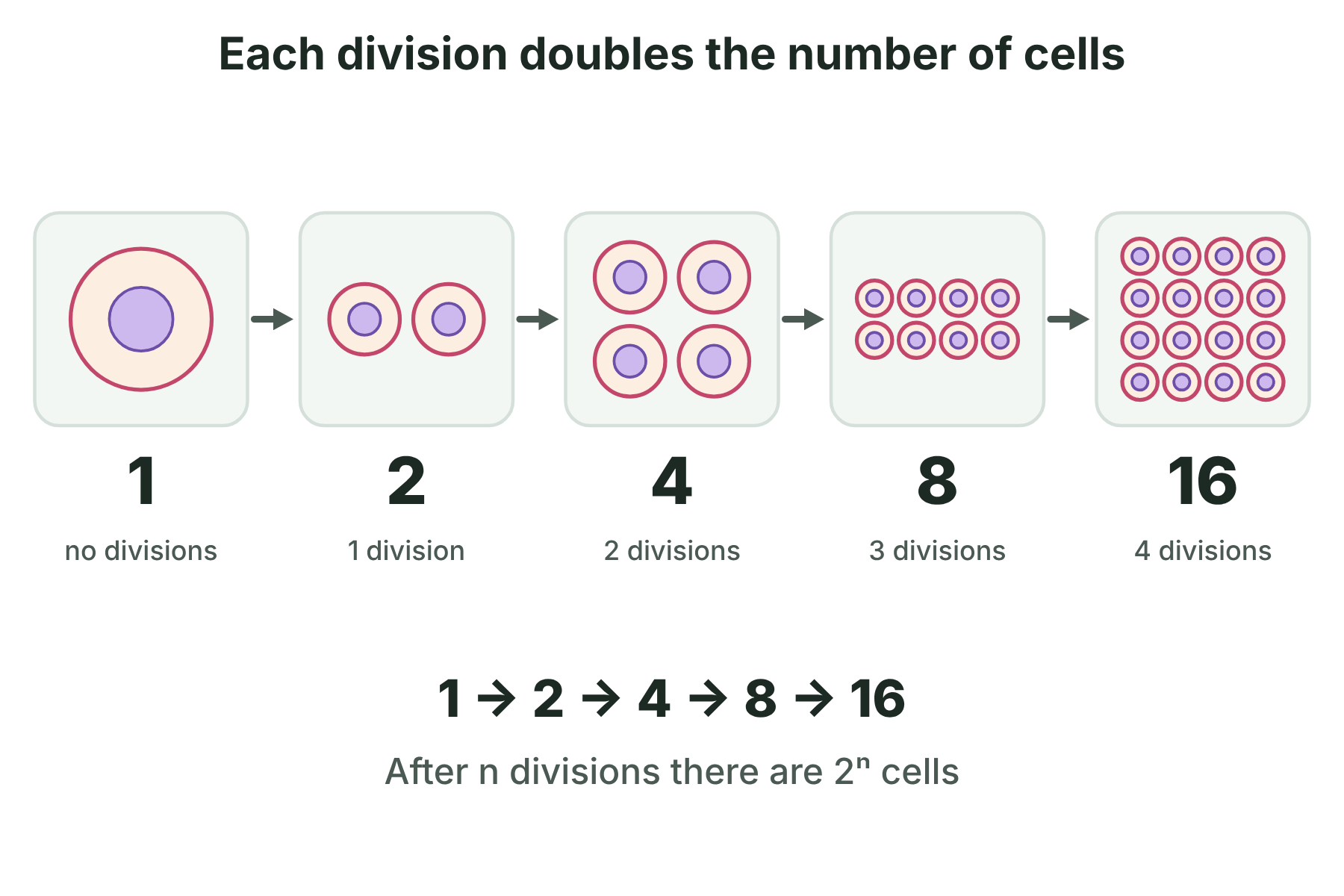
Each division doubles the number of cells.
The Stages of the Cell Cycle in Edexcel's Words
Edexcel names each stage (specification 2.1). Learn the order: interphase, prophase, metaphase, anaphase, telophase, then cytokinesis.
-
1
Interphase
The cell grows, makes more ribosomes and mitochondria, and copies its DNA so that each chromosome has two identical copies.
-
2
Prophase
The chromosomes condense and become visible, each made of two identical copies joined together. The nuclear membrane breaks down.
-
3
Metaphase
The chromosomes line up across the middle of the cell, attached to spindle fibres.
-
4
Anaphase
The spindle fibres pull each pair of copies apart, so one copy of every chromosome moves to each end of the cell.
-
5
Telophase
A new nuclear membrane forms around each set of chromosomes at the two ends of the cell, and the chromosomes unwind.
-
6
Cytokinesis
The cytoplasm and cell membrane divide, making two daughter cells. Each is a genetically identical diploid body cell, with the same chromosomes as the parent cell.
Growth in Animals and Plants
Edexcel asks you to describe growth as cell division followed by differentiation, with an extra step in plants (specification 2.2 and 2.5).
-
Animal growth
Cells divide by mitosis to make more cells, and most of the new cells then differentiate into specialised types. In adults, mitosis mainly replaces and repairs cells.
-
Plant growth
Cells divide by mitosis in the meristems at the tips of roots and shoots. The new cells then elongate, becoming longer as they take in water, before they differentiate.
-
Asexual reproduction
Mitosis makes the new cells of organisms that reproduce asexually, such as a plant that grows new plants from runners. The offspring are genetically identical to the parent.
Percentile Charts and Growth
Doctors use percentile charts to monitor the growth of babies and children (specification 2.7).
-
What a percentile means
It shows what percentage of children of the same age and sex are smaller. A child on the 25th percentile line for mass is heavier than 25% of children of that age and lighter than 75%.
-
The 50th percentile
The middle line: half of children are above it and half are below it.
-
Using the chart
Plot the child's measurement against their age and read off which line it lies on, or between. What matters is whether the child keeps following the same line as they grow.
Case study
Replacing cells in the human body
Mitosis is going on in your body all the time. A red blood cell lives for about four months before it is broken down, and the cells lining the small intestine last only a few days. Stem cells keep dividing by mitosis to make the replacements, so the number of cells stays about the same.
The big idea
Mitosis makes two cells that are genetically identical to the parent cell.
The DNA is copied first, so each new cell gets a full set of chromosomes.
The cell cycle and mitosis
The cell cycle and mitosis
-
Stage 1
- the cell grows
- more ribosomes and mitochondria
- DNA is copied
-
Stage 2: mitosis
- one set of chromosomes to each end
- the nucleus divides
-
Stage 3
- the cytoplasm and cell membrane divide
-
Result
- two genetically identical cells
- same chromosome number
-
Uses
- growth
- repair
- replacement
- asexual reproduction
Summary and exam focus
- The cell cycle has three stages: growth and DNA replication, mitosis, and division of the cytoplasm.
- Before dividing, the cell grows and makes more ribosomes and mitochondria, and its DNA replicates.
- In mitosis one set of chromosomes is pulled to each end of the cell and the nucleus divides.
- Mitosis makes two genetically identical cells with the same number of chromosomes.
- Mitosis is needed for growth, repair, replacement and asexual reproduction.
Exam focus
Describe what happens to the chromosomes during the cell cycle. (4 marks) (4 marks)
Put the events in order and use the words copied, pulled and identical. Mark schemes reward "the DNA is replicated, giving two copies of each chromosome" and "one set is pulled to each end of the cell".
Key terms
The words this lesson expects you to use. Each one is linked from the first place it appears above.
- Cell cycle
- The series of stages a cell goes through to grow, copy its DNA and divide into two cells.
- Mitosis
- The stage of the cell cycle in which one set of chromosomes is pulled to each end of the cell and the nucleus divides.
- DNA replication
- The copying of DNA, so that there are two identical copies of each chromosome.
- Daughter cell
- One of the two cells formed when a cell divides.
- Genetically identical
- Having exactly the same genes.
- Clone
- An organism, or cell, that is genetically identical to its parent.
- Growth
- An increase in the number of cells (and so in the size of an organism).
- Repair
- Replacing damaged cells with new ones made by mitosis.
- Asexual reproduction
- Reproduction with one parent only, using mitosis, so the offspring are genetically identical to it.
- Sub-cellular structure
- A structure inside a cell, such as a nucleus, a mitochondrion or a ribosome.
Questions and answers
17 questions set on this lesson, with the mark schemes and model answers open.
Name the type of cell division that produces two genetically identical cells for growth and repair.
Mark scheme — 1 mark available
- Mitosis — 1 mark
Model answer
Mitosis.
State two reasons why mitosis is important in a human.
Mark scheme — 2 marks available
- Growth / development — 1 mark
- Repair of damaged tissue — 1 mark
- Replacement of cells — 1 mark
Model answer
Any two from: growth (and development); repair of damaged tissue; replacement of worn-out cells.
Figure 1 shows the three stages of the cell cycle. Name the stages A, B and C.
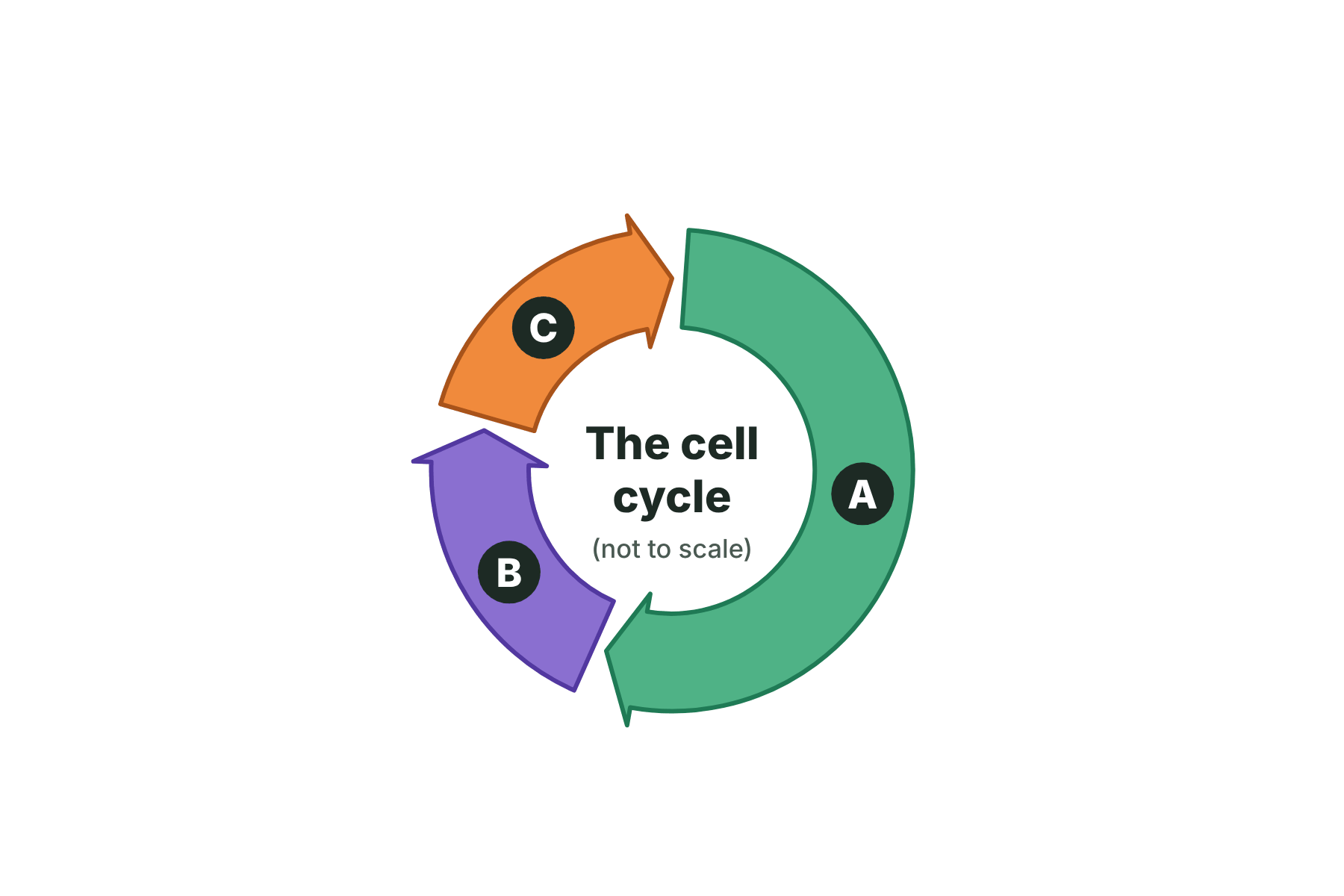
Mark scheme — 3 marks available
- A: growth and DNA replication — 1 mark
- B: mitosis — 1 mark
- C: the cytoplasm (and cell membrane) divides — 1 mark
Model answer
A is growth and DNA replication (accept interphase). B is mitosis. C is the division of the cytoplasm and cell membrane (accept cytokinesis).
Describe what happens in a cell during the first stage of the cell cycle, before mitosis.
Mark scheme — 3 marks available
- The cell grows — 1 mark
- More ribosomes and mitochondria / sub-cellular structures — 1 mark
- DNA replicates, giving two copies of each chromosome — 1 mark
Model answer
The cell grows. The number of sub-cellular structures, such as ribosomes and mitochondria, increases. The DNA replicates to form two copies of each chromosome.
A human skin cell has 46 chromosomes. It divides by mitosis. State the number of chromosomes in each new cell, and explain your answer.
Mark scheme — 2 marks available
- 46 — 1 mark
- DNA replicated first / one copy of every chromosome goes to each new cell — 1 mark
Model answer
46 in each new cell. The DNA is copied before the cell divides, and one copy of each chromosome is pulled to each end, so each new cell gets a full set.
Figure 2 shows six stages of mitosis in the wrong order. Write the letters in the correct order, starting with the cell before it divides.
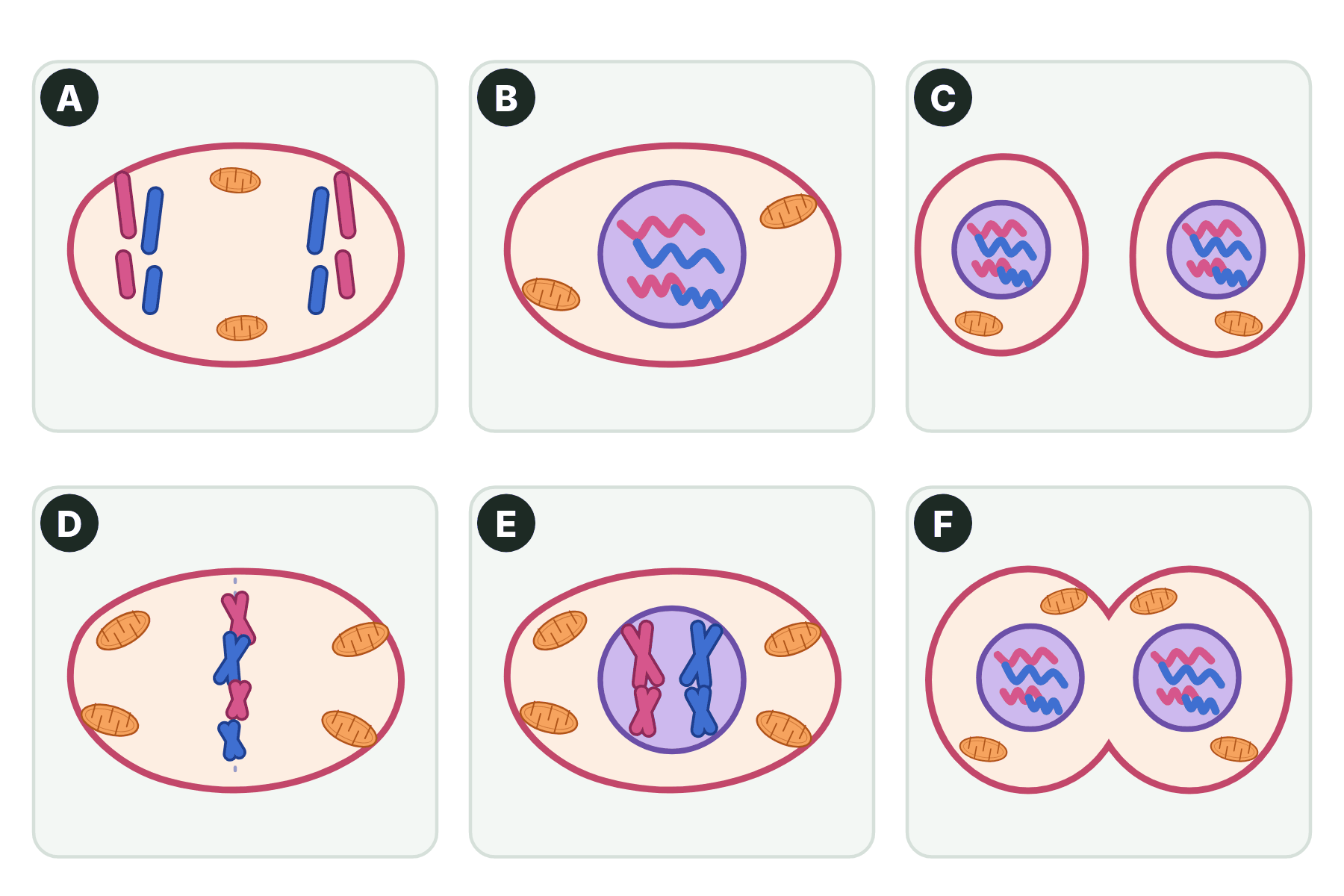
Mark scheme — 2 marks available
- B first and C last — 1 mark
- E, D, A, F in the correct order between them — 1 mark
Model answer
B, E, D, A, F, C.
A cell divides by mitosis. Every new cell then divides, and this happens 5 times in total. Calculate the number of cells at the end.
Mark scheme — 2 marks available
- Doubles each time / \(2^{5}\) — 1 mark
- 32 — 1 mark
Model answer
\(2^{5} = 32\) cells.
Explain how mitosis helps a cut in the skin to heal.
What the examiner wants: Link each point to the next with "so" or "because".
Mark scheme — 4 marks available
- Cells next to the cut divide by mitosis — 1 mark
- New cells are made — 1 mark
- They fill the gap / replace damaged cells — 1 mark
- New cells are genetically identical, so they do the same job — 1 mark
Model answer
Cells at the edge of the cut divide by mitosis. This makes new cells, which fill the gap and replace the damaged cells. The new cells are genetically identical to the original skin cells, so they have the same genes and do the same job, and the skin is repaired.
Describe the stages of the cell cycle, and explain why mitosis produces two genetically identical cells.
What the examiner wants: Cover all three stages in order, then link the copying of the DNA to the identical cells.
Mark scheme — 6 marks available
- The cell grows and makes more ribosomes and mitochondria — 1 mark
- DNA replicates / two copies of each chromosome — 1 mark
- In mitosis one set of chromosomes is pulled to each end — 1 mark
- Nucleus divides, then cytoplasm and membrane divide — 1 mark
- Each new cell gets one copy of every chromosome — 1 mark
- So cells have the same genes / are genetically identical — 1 mark
Model answer
In the first stage the cell grows and the numbers of ribosomes and mitochondria increase. The DNA replicates, giving two identical copies of each chromosome. In mitosis, one set of chromosomes is pulled to each end of the cell and the nucleus divides. Finally the cytoplasm and cell membrane divide, forming two cells. The two cells are genetically identical because the DNA was copied exactly before division and each new cell receives one copy of every chromosome, so each has the same genes and the same number of chromosomes.
How many cells does one cell make when it divides by mitosis?
Why: Mitosis, followed by division of the cytoplasm, makes two cells.
What happens to the DNA before mitosis?
Why: The DNA replicates, giving two identical copies of each chromosome, so that each new cell can have a full set.
What happens to the chromosomes in mitosis?
Why: One set of chromosomes is pulled to each end of the cell and the nucleus divides.
A human cell with 46 chromosomes divides by mitosis. How many chromosomes are in each new cell?
Why: Mitosis makes genetically identical cells with the same number of chromosomes as the parent cell.
Which of these is NOT a job of mitosis?
Why: Mitosis is used for growth, repair and replacement. Making egg and sperm cells uses a different type of cell division, which you meet later in the course.
A cell divides by mitosis 3 times. Every new cell also divides. How many cells are there at the end?
Why: The number doubles each time: 1, 2, 4, 8. That is 2 to the power 3, which is 8.
What are the two new cells formed by mitosis called?
Why: The two cells formed when a cell divides are called daughter cells.
A student says: "The two new cells are identical to the parent cell because they are the same size." What is wrong with this?
Why: Cells being genetically identical means they have the same genes. It is the copying of the DNA before division that makes them identical, not their size or shape.