Viewing as
Teaching this? The teacher view adds 2 files, the mark schemes and the model answers.
Maths · Number
Surds
The square root of 2 can never be written exactly as a decimal or a fraction - but it can be written exactly as a surd. Surds let you give exact answers, simplify roots, and clear roots out of the bottom of a fraction.
Last Lesson and Before
Answer each one, then check.
-
1
What is \(\sqrt{36}\)?
Show answerHide answer
\(6\)
-
2
What is \(\sqrt{4} \times \sqrt{9}\)?
Show answerHide answer
\(2 \times 3 = 6\) - the same as \(\sqrt{36}\).
-
3
Expand \(3(x + 2)\).
Show answerHide answer
\(3x + 6\)
-
4
Last lesson: write \(4 \times 10^3\) as an ordinary number.
Show answerHide answer
\(4000\)
-
5
Which of these is a whole number: \(\sqrt{16}\) or \(\sqrt{17}\)?
Show answerHide answer
\(\sqrt{16} = 4\). \(\sqrt{17}\) is not a whole number.
Learning Objectives
- 1Know what rational and irrational numbers are, and what a surd is.
- 2Simplify surds such as \(\sqrt{72}\).
- 3Multiply, divide, add and subtract surds.
- 4Expand brackets containing surds.
- 5Rationalise the denominator of a fraction such as \(\dfrac{6}{\sqrt{3}}\).
What Is a Surd?
A surd is a root that cannot be written exactly as a fraction or a terminating or recurring decimal.
-
Rational numbers
Can be written as a fraction of two integers: \(\frac{3}{4}\), \(-7\), \(0.6\), \(\sqrt{25} = 5\).
-
Irrational numbers
Cannot: \(\sqrt{2} = 1.414\,213\,56\ldots\), \(\pi = 3.141\,592\,65\ldots\) The decimals never end and never repeat.
-
Surds
Roots that are irrational: \(\sqrt{2}\), \(\sqrt{10}\), \(\sqrt[3]{5}\). \(\sqrt{9}\) is not a surd, because \(\sqrt{9} = 3\).
-
Why use them
\(\sqrt{2}\) is exact; 1.414 is not. When a question says "give your answer in surd form", it wants the exact answer.
Rational or Irrational?
Rational
- \(\frac{3}{4}\)
- \(0.666\ldots = \frac{2}{3}\)
- \(\sqrt{25} = 5\)
- \(-7\)
- \(\sqrt{\frac{4}{9}} = \frac{2}{3}\)
Irrational
- \(\sqrt{2}\)
- \(\sqrt{10}\)
- \(\pi\)
- \(\sqrt[3]{5}\)
- \(1 + \sqrt{3}\)
The Rules for Surds
Roots can be split up and combined when multiplying and dividing - but not when adding.
-
Multiplying
\(\sqrt{a} \times \sqrt{b} = \sqrt{ab}\). \(\sqrt{2} \times \sqrt{8} = \sqrt{16} = 4\).
-
Dividing
\(\dfrac{\sqrt{a}}{\sqrt{b}} = \sqrt{\dfrac{a}{b}}\). \(\dfrac{\sqrt{50}}{\sqrt{2}} = \sqrt{25} = 5\).
-
A surd times itself
\(\sqrt{a} \times \sqrt{a} = a\). \(\sqrt{7} \times \sqrt{7} = 7\).
-
Not for adding
\(\sqrt{a + b}\) is NOT \(\sqrt{a} + \sqrt{b}\): \(\sqrt{9 + 16} = \sqrt{25} = 5\), but \(\sqrt{9} + \sqrt{16} = 7\).
Surds in Right-Angled Triangles
Surds turn up all the time in geometry. A right-angled triangle with shorter sides 1 and 1 has a hypotenuse of exactly \(\sqrt{2}\) - a length you can draw perfectly but never write exactly as a decimal.
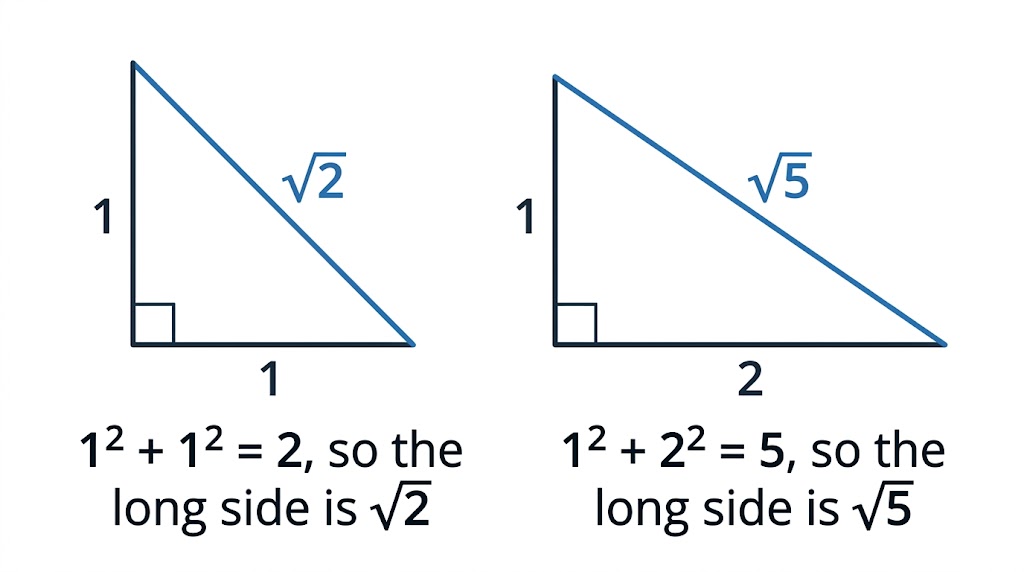
The long side of a right-angled triangle is often a surd.
Simplifying a Surd
Simplify \(\sqrt{72}\)
Show the solutionHide the solution
- 1 Find the largest square number that is a factor of 72 Square numbers: 4, 9, 16, 25, 36 ... and \(36 \times 2 = 72\)
- 2 Split the root \(\sqrt{72} = \sqrt{36} \times \sqrt{2}\)
- 3 Work out the square root \(\sqrt{36} = 6\)
Answer\(\sqrt{72} = 6\sqrt{2}\)
Adding Surds
Simplify \(\sqrt{50} + \sqrt{18}\)
Show the solutionHide the solution
- 1 Simplify each surd \(\sqrt{50} = \sqrt{25} \times \sqrt{2} = 5\sqrt{2}\) and \(\sqrt{18} = \sqrt{9} \times \sqrt{2} = 3\sqrt{2}\)
- 2 They are now "like surds" - both multiples of \(\sqrt{2}\) \(5\sqrt{2} + 3\sqrt{2}\)
- 3 Add them like algebra: \(5x + 3x = 8x\) \(8\sqrt{2}\)
Answer\(8\sqrt{2}\)
Expanding Brackets with Surds
Expand and simplify \((3 + \sqrt{2})(5 - \sqrt{2})\)
Show the solutionHide the solution
- 1 First times first \(3 \times 5 = 15\)
- 2 Outer and inner \(3 \times (-\sqrt{2}) = -3\sqrt{2}\) and \(\sqrt{2} \times 5 = 5\sqrt{2}\)
- 3 Last times last \(\sqrt{2} \times (-\sqrt{2}) = -2\)
- 4 Collect like terms \(15 - 2 = 13\) and \(-3\sqrt{2} + 5\sqrt{2} = 2\sqrt{2}\)
Answer\(13 + 2\sqrt{2}\)
Rationalising the Denominator
To rationalise a fraction like \(\dfrac{a}{\sqrt{b}}\), multiply the top AND the bottom by \(\sqrt{b}\).
-
Why it works
Multiplying top and bottom by the same number does not change a fraction's value, and \(\sqrt{b} \times \sqrt{b} = b\) removes the surd from the bottom.
-
Example
\(\dfrac{6}{\sqrt{3}} = \dfrac{6 \times \sqrt{3}}{\sqrt{3} \times \sqrt{3}} = \dfrac{6\sqrt{3}}{3} = 2\sqrt{3}\).
-
Always simplify
Cancel any common factors, and simplify any surd left on top.
-
Exam wording
"Rationalise the denominator" and "give your answer in the form \(a\sqrt{b}\)" both mean do this.
Rationalising
Rationalise the denominator of \(\dfrac{10}{\sqrt{5}}\). Give your answer in its simplest form.
Show the solutionHide the solution
- 1 Multiply the top and the bottom by \(\sqrt{5}\) \(\dfrac{10 \times \sqrt{5}}{\sqrt{5} \times \sqrt{5}}\)
- 2 The bottom becomes a whole number \(\sqrt{5} \times \sqrt{5} = 5\)
- 3 So \(\dfrac{10\sqrt{5}}{5}\)
- 4 Simplify \(10 \div 5 = 2\)
Answer\(2\sqrt{5}\)
Case study
A4 Paper and the Square Root of 2
Every A-size sheet of paper - A3, A4, A5 - has its long side \(\sqrt{2}\) times its short side. That is the one shape that stays exactly the same when you fold it in half: halve the long side of a sheet with sides 1 and \(\sqrt{2}\) and you get sides \(\frac{\sqrt{2}}{2}\) and 1, which is the same shape again. It is why an A4 page shrinks perfectly onto A5 on a photocopier. An A4 sheet is 210 mm by 297 mm, and \(297 \div 210 = 1.414\ldots\), which is \(\sqrt{2}\) to the nearest millimetre.
Folding A-Size Paper
Halving an A-size sheet always makes the next size down, with exactly the same shape. The ratio of the sides is \(1 : \sqrt{2}\) at every size - a surd you use every day.
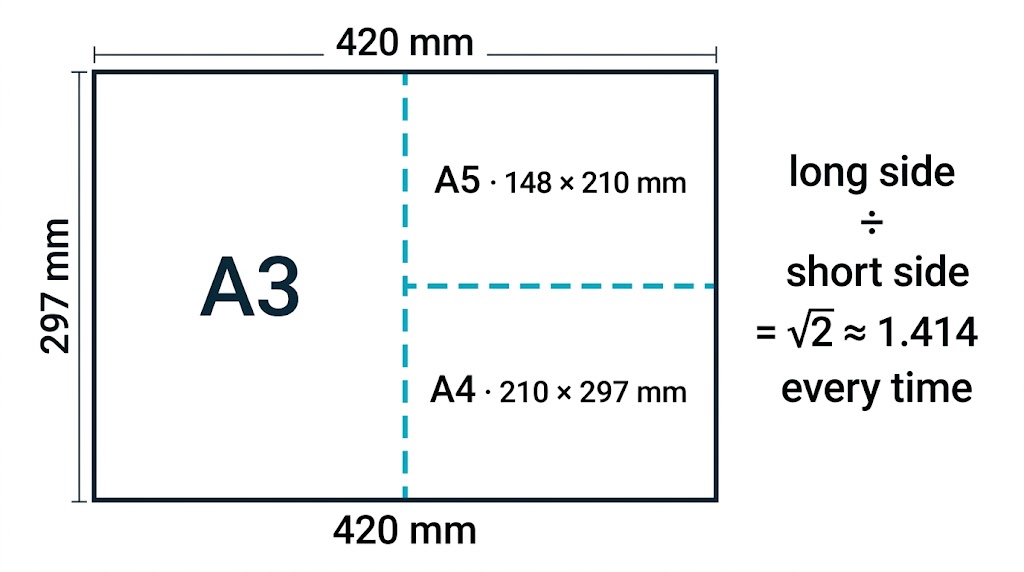
Fold A3 in half and you get A4; fold A4 in half and you get A5.
Surd Simplifying Race
Simplify each. (a) \(\sqrt{12}\) (b) \(\sqrt{45}\) (c) \(\sqrt{200}\) (d) \(\sqrt{8} + \sqrt{32}\) (e) \(\sqrt{75} - \sqrt{27}\) (f) \(\sqrt{3} \times \sqrt{15}\) (g) \((1 + \sqrt{3})^2\) (h) \(\dfrac{12}{\sqrt{6}}\)
1. Look for the largest square factor.
2. Simplify before adding or subtracting.
3. Rationalise any surd in the denominator.
A good answer shows: (a) \(2\sqrt{3}\) (b) \(3\sqrt{5}\) (c) \(10\sqrt{2}\) (d) \(2\sqrt{2} + 4\sqrt{2} = 6\sqrt{2}\) (e) \(5\sqrt{3} - 3\sqrt{3} = 2\sqrt{3}\) (f) \(\sqrt{45} = 3\sqrt{5}\) (g) \(1 + 2\sqrt{3} + 3 = 4 + 2\sqrt{3}\) (h) \(\dfrac{12\sqrt{6}}{6} = 2\sqrt{6}\)
Can I...?
- 1Explain what a surd is.
- 2Say whether a number is rational or irrational.
- 3Simplify a surd such as \(\sqrt{72}\).
- 4Multiply and divide surds.
- 5Add and subtract like surds.
- 6Expand brackets containing surds.
- 7Rationalise a denominator like \(\dfrac{a}{\sqrt{b}}\).
- 8Give an exact answer in surd form.
Summary & Exam Focus
- A surd is an irrational root, and gives an exact value.
- \(\sqrt{ab} = \sqrt{a} \times \sqrt{b}\): take out the largest square factor to simplify.
- Only like surds can be added or subtracted.
- Rationalise \(\dfrac{a}{\sqrt{b}}\) by multiplying the top and the bottom by \(\sqrt{b}\).
Exam focus
Rationalise the denominator of \(\dfrac{12}{\sqrt{3}}\). Give your answer in its simplest form. (2 marks) (2 marks)
"Exact" or "surd form" means do not use a decimal. Leave the root in the answer and simplify it as far as it goes.
Key terms
The vocabulary this lesson expects you to use. Each one is linked from the first place it appears above.
- Rational number
- A number that can be written as a fraction of two integers.
- Irrational number
- A number that cannot be written as a fraction; its decimal never ends or repeats.
- Surd
- A root that is irrational, such as \(\sqrt{2}\) or \(\sqrt{10}\).
- Like surds
- Multiples of the same surd, such as \(5\sqrt{2}\) and \(3\sqrt{2}\), which can be added and subtracted.
- Simplest form
- A surd with the largest possible square number taken out, e.g. \(6\sqrt{2}\).
- Rationalise the denominator
- Rewrite a fraction so there is no surd on the bottom.
Practice questions
Have a go at each one before you open its answer.
-
Question 1 Non-calculator 1 mark
Write \(\sqrt{45}\) in the form \(k\sqrt{5}\), where \(k\) is an integer.
Show answerHide answer
Model answer
\(\sqrt{45} = \sqrt{9} \times \sqrt{5} = 3\sqrt{5}\)
Mark scheme
- \(3\sqrt{5}\) — B1
-
Question 2 Non-calculator 2 marks
Rationalise the denominator of \(\dfrac{12}{\sqrt{3}}\). Give your answer in its simplest form.
Show answerHide answer
Model answer
\(\dfrac{12}{\sqrt{3}} \times \dfrac{\sqrt{3}}{\sqrt{3}} = \dfrac{12\sqrt{3}}{3} = 4\sqrt{3}\)
Mark scheme
- Multiplying the top and the bottom by \(\sqrt{3}\) — M1
- \(4\sqrt{3}\) — A1
-
Question 3 Non-calculator 3 marks
Expand and simplify \((2 + \sqrt{3})(4 - \sqrt{3})\). Give your answer in the form \(a + b\sqrt{3}\), where \(a\) and \(b\) are integers.
Show answerHide answer
Model answer
\(8 - 2\sqrt{3} + 4\sqrt{3} - 3 = 5 + 2\sqrt{3}\)
Mark scheme
- At least 3 of the 4 terms correct: \(8\), \(-2\sqrt{3}\), \(4\sqrt{3}\), \(-3\) — M1
- All 4 terms correct — M1
- \(5 + 2\sqrt{3}\) — A1
-
Question 4 Non-calculator · Show that 3 marks
Show that \(\sqrt{98} + \sqrt{8} = 9\sqrt{2}\)
Show answerHide answer
Model answer
\(\sqrt{98} = \sqrt{49} \times \sqrt{2} = 7\sqrt{2}\). \(\sqrt{8} = \sqrt{4} \times \sqrt{2} = 2\sqrt{2}\). \(7\sqrt{2} + 2\sqrt{2} = 9\sqrt{2}\).
Mark scheme
- \(\sqrt{98} = 7\sqrt{2}\) or \(\sqrt{8} = 2\sqrt{2}\) — M1
- Both simplified correctly — M1
- Correctly added to reach \(9\sqrt{2}\) — A1
-
Question 5 Non-calculator 3 marks
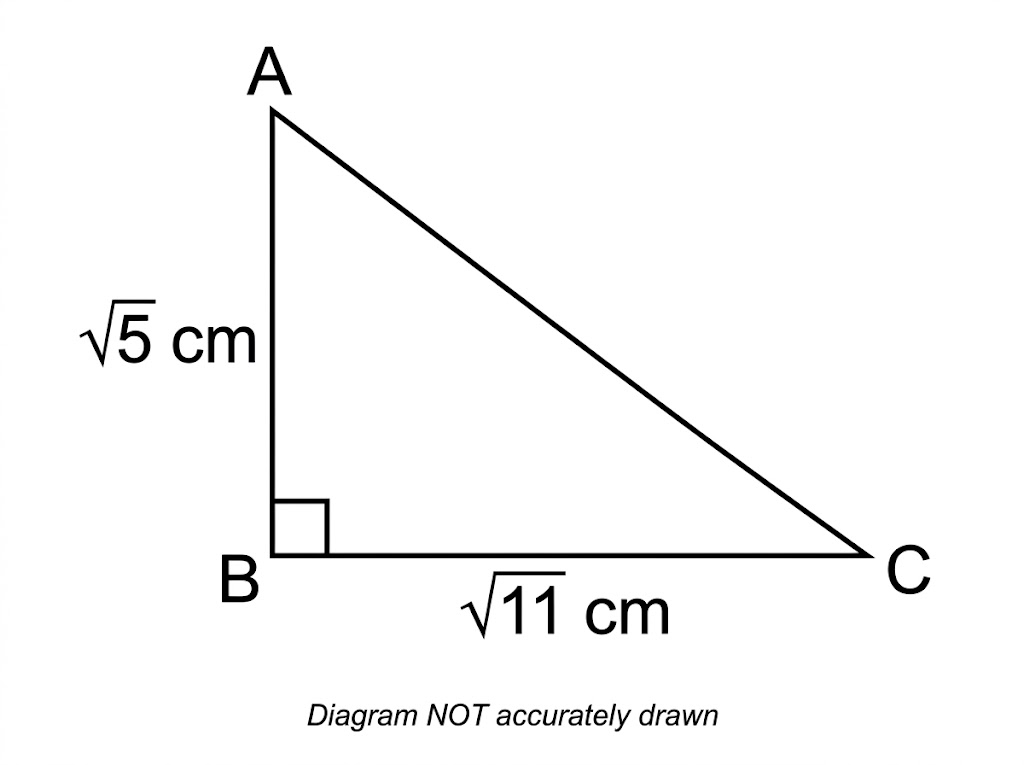
The diagram shows the right-angled triangle ABC. \(AB = \sqrt{5}\) cm and \(BC = \sqrt{11}\) cm. Work out the length of \(AC\).
Show answerHide answer
Model answer
\(AC^2 = (\sqrt{5})^2 + (\sqrt{11})^2 = 5 + 11 = 16\), so \(AC = \sqrt{16} = 4\) cm.
Mark scheme
- \((\sqrt{5})^2 + (\sqrt{11})^2\) or \(5 + 11\) — M1
- \(\sqrt{16}\) — M1
- 4 (cm) — A1
-
Question 6 Non-calculator 3 marks
A rectangle has length \((3 + \sqrt{5})\) cm and width \((3 - \sqrt{5})\) cm. Work out the area of the rectangle.
Show answerHide answer
Model answer
\((3 + \sqrt{5})(3 - \sqrt{5}) = 9 - 3\sqrt{5} + 3\sqrt{5} - 5 = 4\) cm²
Mark scheme
- Area \(= (3 + \sqrt{5})(3 - \sqrt{5})\) — M1
- At least 3 of the 4 terms correct: \(9\), \(-3\sqrt{5}\), \(+3\sqrt{5}\), \(-5\) — M1
- 4 (cm²) — A1
Quick check
-
What is \(\sqrt{12}\) in its simplest form?
Show answerHide answer
B: \(2\sqrt{3}\)
\(12 = 4 \times 3\), and \(\sqrt{4} = 2\), so \(\sqrt{12} = 2\sqrt{3}\).
-
What is \(\sqrt{2} + \sqrt{8}\)?
Show answerHide answer
C: \(3\sqrt{2}\)
\(\sqrt{8} = 2\sqrt{2}\), so \(\sqrt{2} + 2\sqrt{2} = 3\sqrt{2}\).
-
Rationalise the denominator of \(\dfrac{6}{\sqrt{2}}\).
Show answerHide answer
A: \(3\sqrt{2}\)
Multiply the top and bottom by \(\sqrt{2}\): \(\dfrac{6\sqrt{2}}{2} = 3\sqrt{2}\).
Downloads
Free to keep, print and annotate.
Something here looks wrong?
Tell us what and we will go and look. It goes to whoever writes these pages, nobody else, and we do not ask who you are — so there is nothing to sign and nothing comes back to you.